How to Get Your Content Cited in Google AI Overviews
M. Zeeshan, Founder of GEOREX AI
Generative Engine & AI Search Intelligence
Share:
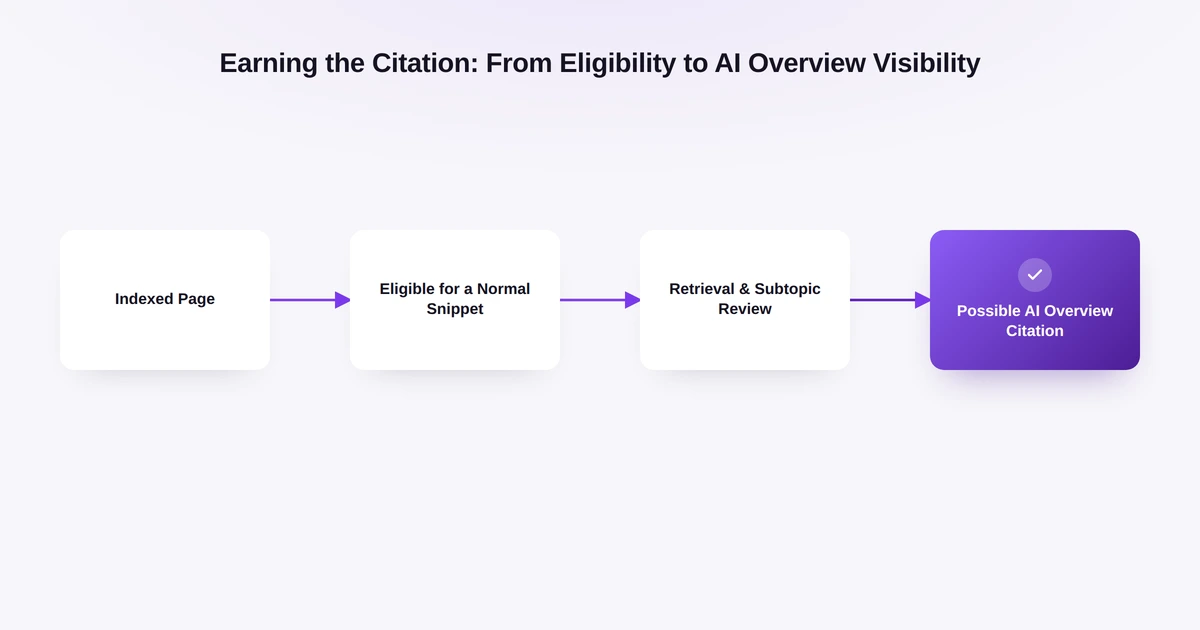
"Your page can be cited in Google AI Overviews only if it is indexed and eligible to show a normal snippet in Google Search, with no nosnippet or restrictive max-snippet rule blocking it. From that eligible pool, retrieval and query fan-out pull in pages that answer the question's subtopics, but meeting the requirements still does not guarantee selection."
Key takeaways
A page can be a supporting link in AI Overviews or AI Mode only if it is indexed and eligible to show a normal Search snippet; meeting that bar still does not guarantee selection.
No special schema, AI text file or markup is required, and any structured data must match the visible content.
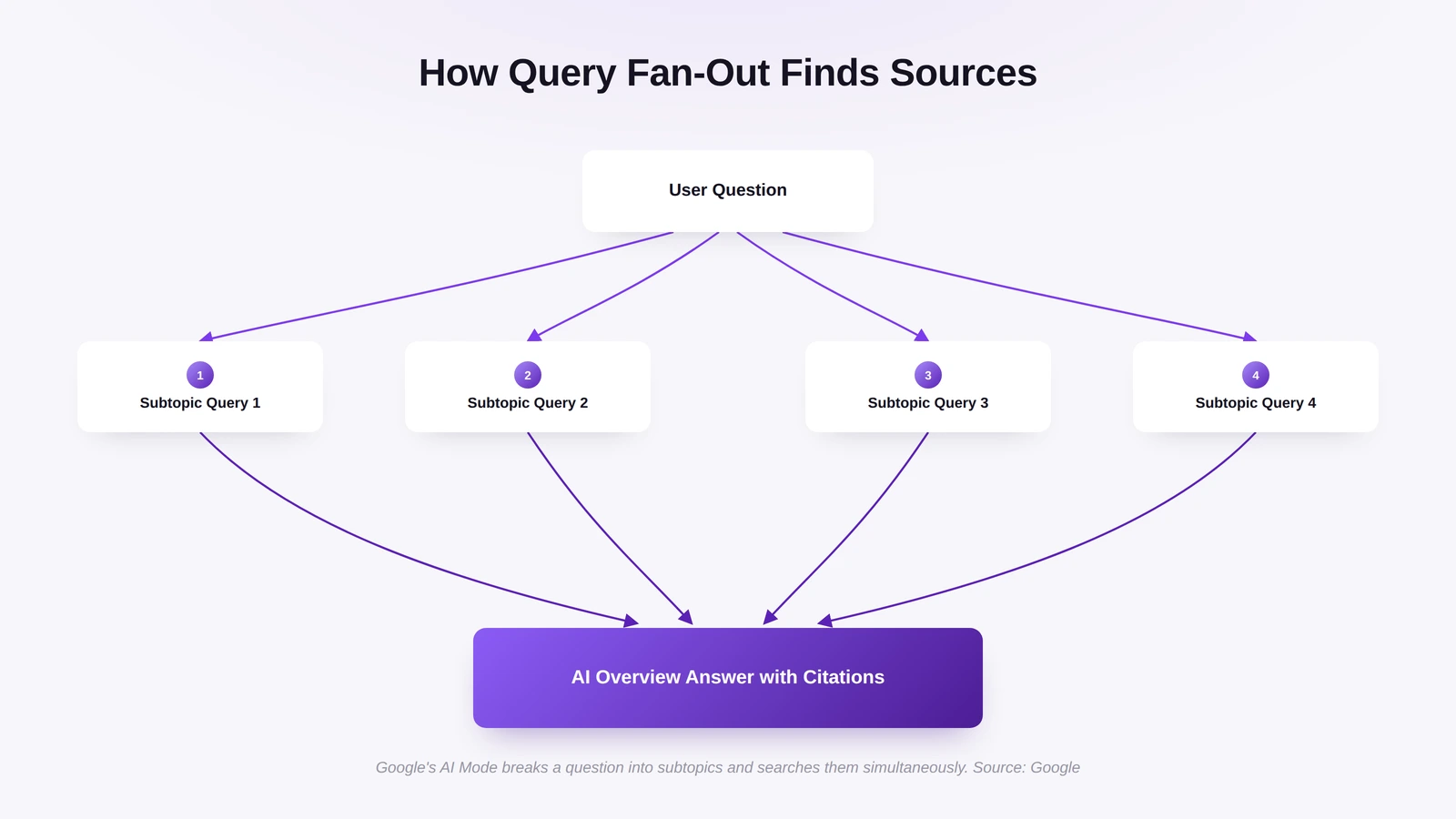
Google finds sources with retrieval from its Search index plus query fan-out, which splits one question into subtopics searched at the same time.
Search Console counts AI Overviews traffic inside the Web search type; it does not tell you which answers cited you.
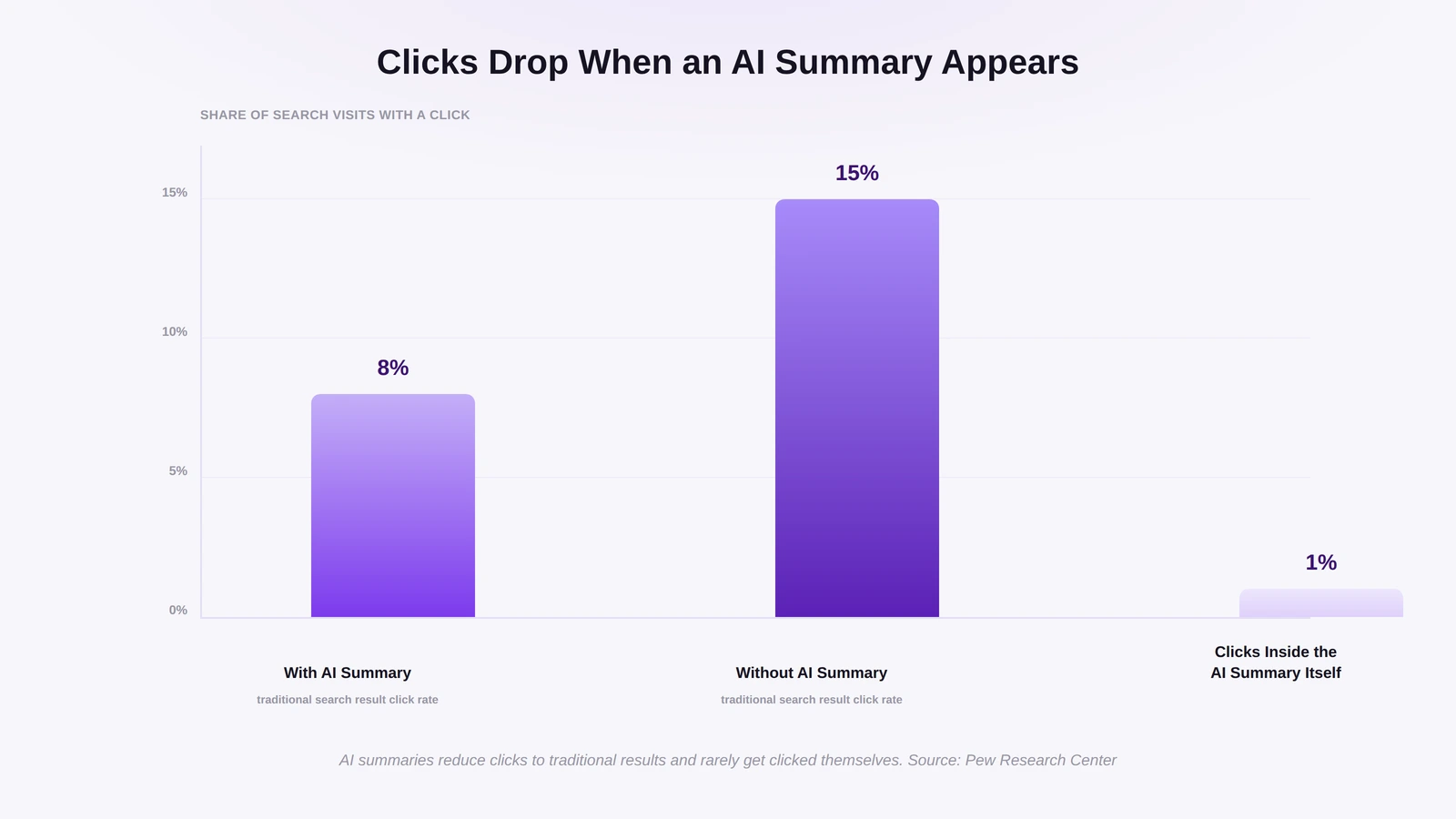
Citations and clicks are separate outcomes: in Pew Research Center's data, people clicked a link inside an AI summary in only 1% of visits.
Is your page eligible to be a supporting link?
A page can only be used as a supporting link in AI Overviews or AI Mode if it is indexed and eligible to show a normal snippet in Google Search, and Google says no special schema markup or AI-specific file is needed for that (Google Search Central). Eligibility is a floor, not a promise: Google may still not crawl, index or show the page. For how this fits the wider discipline, see our guide to .
M. Zeeshan, Founder of GEOREX AI
Author
Founder of GEOREX AI, an AI visibility platform that tracks how brands actually appear across ChatGPT, Claude, Perplexity, and Gemini, and turns the gaps it finds into a prioritized action plan.
Boost Your Brand in Generative Search
Turn AI engines into your highest-converting acquisition channel.
GEOREX monitors how ChatGPT, Gemini, Google AI Overviews, Perplexity, and Claude cite your brand across thousands of real buyer queries and provides actionable optimization playbooks.
Check that the URL is in the Google index with the URL Inspection tool in Search Console.
Confirm the page returns a 200 status, has no conflicting canonical tag and is not blocked by robots.txt.
See whether the page already earns impressions for related queries in the Performance report. It is not a requirement, but it shows Google already treats the page as relevant to the topic.
If indexing fails, fix that before anything else. A page that is not indexed cannot be selected, however good it is.
Stops the page's content from being used as a direct input for AI Overviews and AI Mode
Only on pages you never want quoted
max-snippet
Limits how much text Google can use from the page
Rarely; a low limit starves AI features of your answer
data-nosnippet
Excludes one marked section of the page from snippets
Around legal text or boilerplate, never around the answer
A common trap: a team applies nosnippet site-wide to protect thin pages, then wonders why its best guide is never cited.
Keep structured data consistent with visible content
Structured data should describe what a visitor actually sees on the page (Google Search Central). Check that FAQ, product or article markup matches the live headings and text, not an older version of the page. Mismatched markup does not help, and it can blur what the page is about.
How does Google find sources for AI Overviews and AI Mode?
Google selects sources through retrieval from its Search index and a subtopic-splitting process called query fan-out, not through any submission or tagging system.
AI Mode breaks a question into subtopics and searches them at the same time. Source: Google
Retrieval from the Search index
Google describes its AI search features as retrieval-augmented generation: core ranking systems retrieve relevant, current pages from the Search index, and other systems review those pages to write a response with supporting links (Google's AI optimization guide). Because retrieval depends on the index, a page that is missing from it, or blocked by nosnippet, cannot be used, however well it is written.
What query fan-out means for coverage
Query fan-out means Google runs several related searches at once to cover the subtopics of one question. Google's May 2025 update says AI Mode breaks a question into subtopics and searches them simultaneously, going deeper than a traditional search (Google's AI Mode update), and its Search Help page describes the same technique across multiple data sources (Google Search Help).
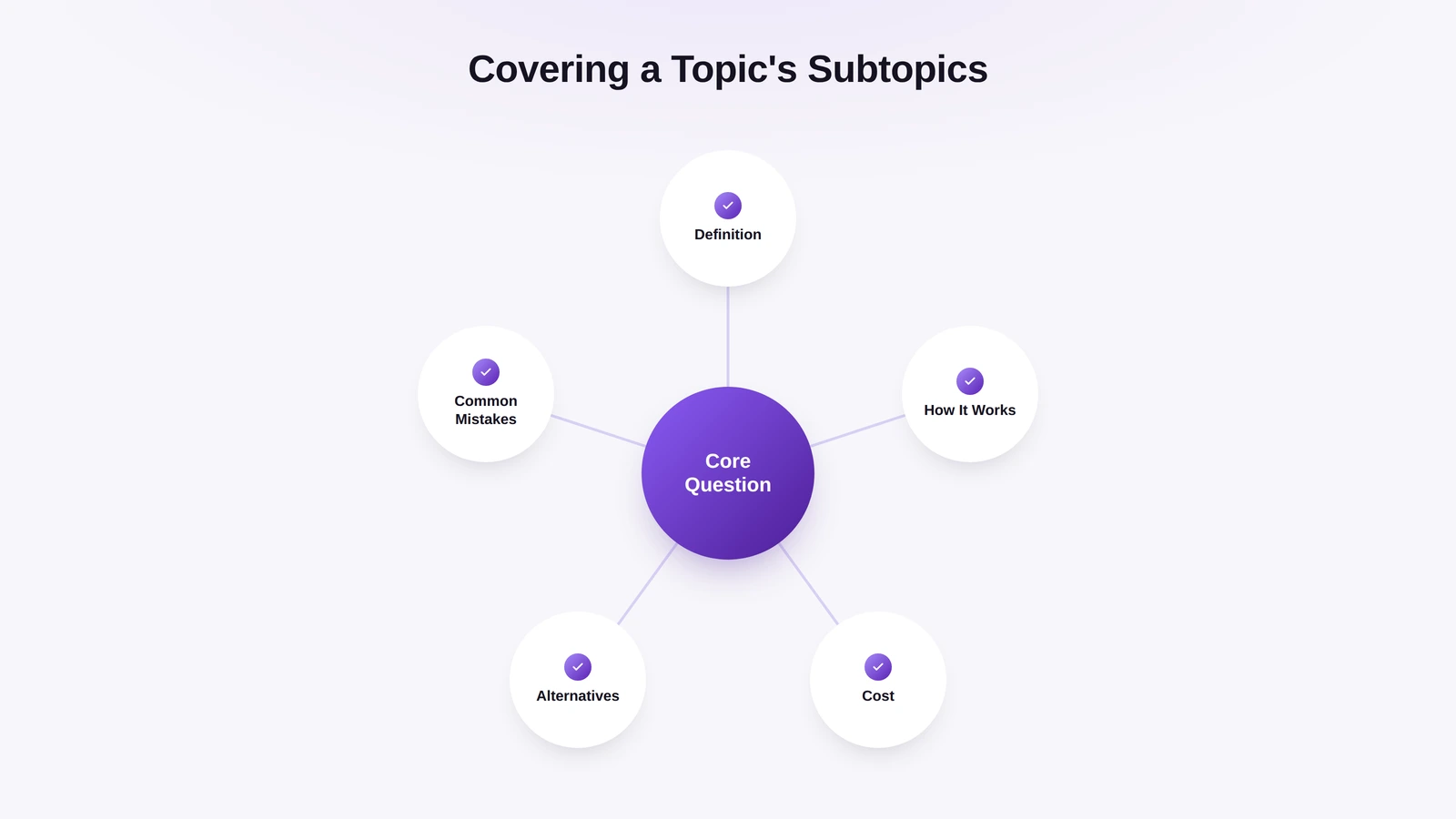
For content teams, this matters more than chasing one exact phrase. A page about running shoe cushioning might be retrieved for a fan-out query about impact absorption, while a separate section on fit answers a different subtopic. Covering the subtopics on one page, or across a well-linked set of pages, raises the odds of matching one of them.
What content gets cited across related subtopics?
A page earns consideration when it answers the core question directly and then covers the questions a reader asks next. None of this guarantees selection, but it matches how Google describes retrieving and reviewing pages to build an answer.
Answer the main question, then the follow-ups
Open each page or major section with a direct, one- or two-sentence answer to its heading, then add detail.
Find the questions readers ask next, using People also ask, related searches and your own support tickets, and give each one its own short subsection.
Keep each section to one subtopic, so a retrieval system can lift a clean passage.
Make important claims easy to verify
State specific facts, figures and dates instead of vague summaries, and attribute them to a named source or your own data.
Update time-sensitive details such as prices, statistics and policies on a schedule, and show a visible last-updated date.
Follow Google's helpful content guidance: write for people first, show real experience or testing, and avoid thin pages built only to target a query.
Use structure to clarify, not to game eligibility
Use headings, short paragraphs, lists and tables to make the page scannable, never to stuff keywords.
Add structured data only where it matches what visitors see.
If one section should not be quoted, such as a legal disclaimer, wrap only that text in data-nosnippet instead of blocking the whole page.
How do you measure AI Overviews visibility in Search Console?
Search Console shows the traffic side; it does not show which answers cited you. Track the two separately.
Track impressions and clicks in the Web search type
Search Console's Web search type includes clicks and impressions from AI Overviews and AI Mode, without a separate filter for them (Google Search Central). Treat these numbers as traffic signals, not a citation count. A page can gain impressions from an AI Overview and still get almost no clicks, and a jump in impressions can come from either regular results or AI features.
Compare page and query trends
Filter the Performance report by page, then run the same date range by query, and look for where the two diverge. If one page's clicks fall while impressions for your topic's queries hold, the page itself may have dropped out of the cited sources. If both fall together, the cause is more likely a change in search behavior than a problem with the page.
Check citations separately from traffic
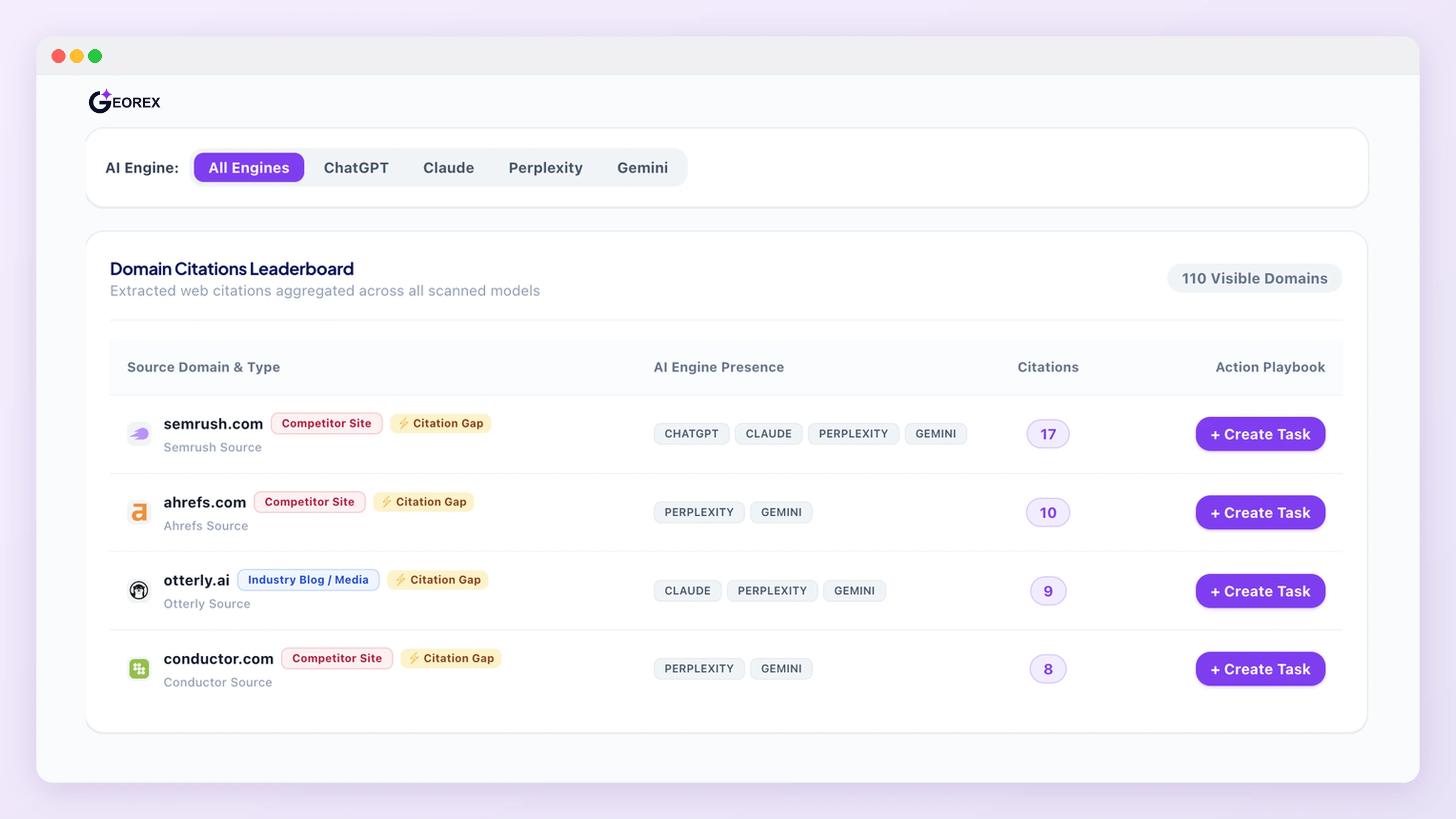
To know whether you are cited, you have to look at the answers. Keep a fixed set of prompts for each important page, check which sites Google AI Overviews cites for each one on a schedule, and log whether your page appears. Tools such as GEOREX AI automate this: for the prompts a brand tracks, it records whether Google shows an AI Overview, whether the brand is mentioned and which websites are cited.
Which sites AI engines cite for your prompts, and where competitors are cited instead (GEOREX Citations)
Getting cited in an AI Overview does not guarantee a visit. Citation and traffic are separate outcomes, and tracking them as one number will mislead a content team.
Share of search visits with a click. Source: Pew Research Center, 2025
A citation is not the same as a click
In Pew Research Center's analysis of 68,879 Google searches from March 2025, people clicked a traditional result in 8% of visits when an AI summary appeared, versus 15% without one, and clicked a link inside the summary in just 1% of visits (Pew Research Center, 2025). Most AI summaries in that study cited three or more sources, so a citation usually means sharing the answer with other sites.
Ahrefs found the same direction in late 2025: AI Overviews cut the click-through rate of the first organic result by 58%, with smaller drops further down the page (Ahrefs' 2025 study).
Use traffic and visibility as separate measures
Report citation frequency and clicks as two metrics, not one blended score. A page can be cited consistently in prompt checks while Search Console shows flat clicks for the same query, and both readings can be right. Visibility inside the answer builds recognition even when the click does not come.
Which mistakes stop pages from being cited?
Most citation failures come from blocked content, false fixes, or confusing eligibility with selection.
Blocking the content Google needs
Site-wide nosnippet: A single CMS default can apply nosnippet to hundreds of pages without anyone noticing; audit your templates.
A tiny max-snippet value: It starves AI features of your answer even when the page is otherwise eligible.
data-nosnippet in the wrong place: Wrap boilerplate or legal text, never the answer paragraph.
Relying on AI-specific shortcuts
Invented "AI schema": Google says no special markup or AI text file is required; use standard structured data that matches the page.
Treating Google-Extended as an AI Overviews switch: Google-Extended controls Gemini training and grounding in Gemini apps, and Google says it does not affect inclusion in Google Search (Google's crawler documentation). AI Overviews draw on the normal Search index.
Paying for or "submitting" pages to AI Overviews: No such channel exists.
Treating eligibility as selection
Passing every check makes a page eligible, not chosen. Treat technical fixes as the floor and keep improving depth, specificity and freshness, the things that decide which eligible page gets used.
How do you monitor citations over time?
A single check proves nothing. Treat eligibility, Search Console trends and observed citations as three signals to recheck on a schedule.
Record a baseline
Note the page's index status and snippet controls.
Save its impressions and clicks in the Web search type, with the date range.
Run a small, fixed set of prompts for the page's topic and record which sites AI Overviews cites, including yours.
List the structured data on the page.
Recheck after meaningful updates
Rerun the same checks after changing titles, headings, snippet controls or structured data.
Compare Search Console trends with the baseline over several weeks, not single days.
Rerun the same prompts. Google retrieves current pages each time a query runs, so results can change even when nothing changed on your side.
Check monthly for routine pages and every two weeks right after a content or technical change.
No. Google's documented requirement is that a page is indexed and eligible to appear in Search with a snippet; a top-ten ranking is not listed as a prerequisite. Meeting that condition still does not guarantee Google will use the page for a given answer.
How to Measure AI Visibility: Mentions, Citations and Share of Voice
The three numbers that measure AI visibility, how to calculate each one, how to build a prompt set that stays comparable, and where AI traffic shows up in GA4 and Search Console.