AI Visibility•11 min read•Updated · Published Sep 15, 2026
What Is Generative Engine Optimization (GEO)? The Complete 2026 Guide
M. Zeeshan, Founder of GEOREX AI
Generative Engine & AI Search Intelligence
Share:
Ask ChatGPT or Google's AI Overview which tool, agency or product to choose, and the answer names a few brands and links a few pages. If your brand is not one of them, the buyer may never see you. This guide covers what GEO is, how it differs from SEO, how each AI engine picks its sources, and how to measure your results.
Key takeaways
GEO optimizes for being mentioned or cited inside AI-generated answers; SEO optimizes for a ranking position on a results page.
In the original GEO study, adding quotations, statistics and cited sources raised visibility in AI answers by up to 40%, while keyword stuffing did not help (GEO: Generative Engine Optimization).
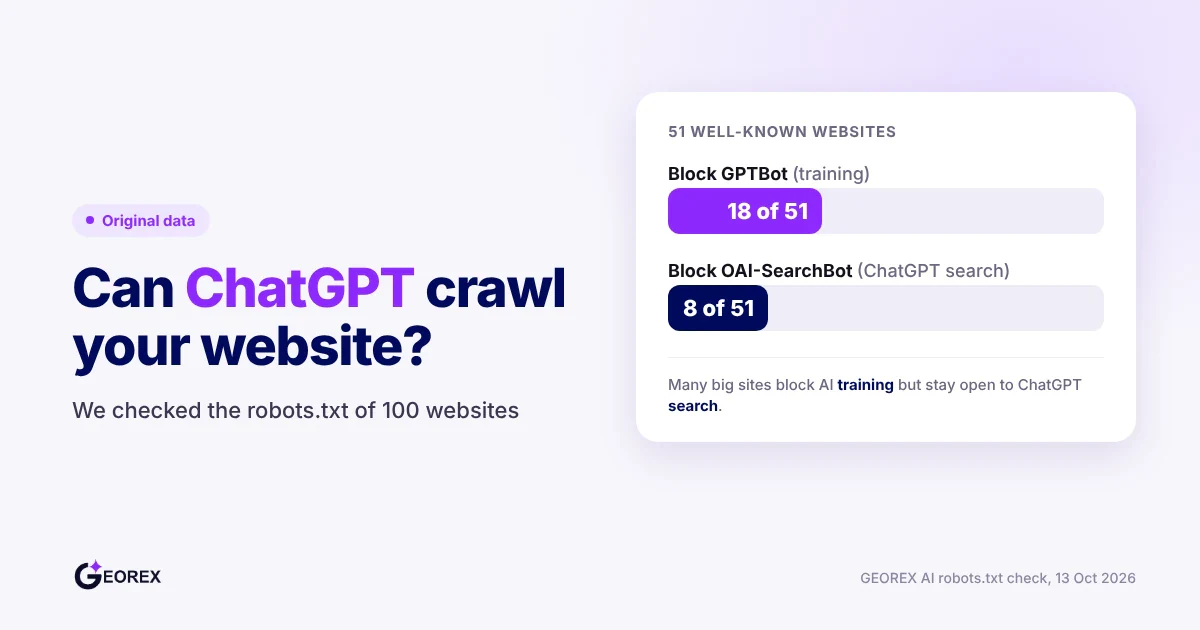
OpenAI and Anthropic run separate crawlers for search and for model training, so you can allow AI search while blocking training.
Google AI Overviews and AI Mode only use pages that are indexed and eligible for a snippet, and they need no special markup (Google Search Central).
Measure GEO with a fixed prompt set: mention rate, citation rate and share of voice per engine, tracked over time.
What is generative engine optimization (GEO)?
Generative engine optimization (GEO) is the practice of making your brand easier for AI engines like ChatGPT, Gemini, Perplexity, Claude and Google AI Overviews to find, trust and quote. Success means your brand is named in the answer and your page is cited as a source.
M. Zeeshan, Founder of GEOREX AI
Author
Founder of GEOREX AI, an AI visibility platform that tracks how brands actually appear across ChatGPT, Claude, Perplexity, and Gemini, and turns the gaps it finds into a prioritized action plan.
Free AI visibility audit
See how AI engines describe your brand today
Check ChatGPT, Gemini and Google AI Overviews in minutes. No credit card needed.
The name comes from the 2024 research paper that introduced it (Aggarwal et al., KDD 2024). Some people call the same work answer engine optimization (AEO), and many search for it as "GEO optimization". Whatever you call it, you measure it by mention rate and citation rate per engine, not by a ranking position.
AI visibility needs its own attention because it does not move in lockstep with search rankings. A page can rank well on Google and still be missing from a chatbot's answer, because each engine retrieves, weighs and cites sources in its own way. The original study tested GEO methods on a 10,000-query benchmark and found visibility gains of up to 40%, with results that varied by domain (the GEO paper). That variance is why GEO needs its own measurement rather than a borrowed SEO scorecard.
How is GEO different from SEO?
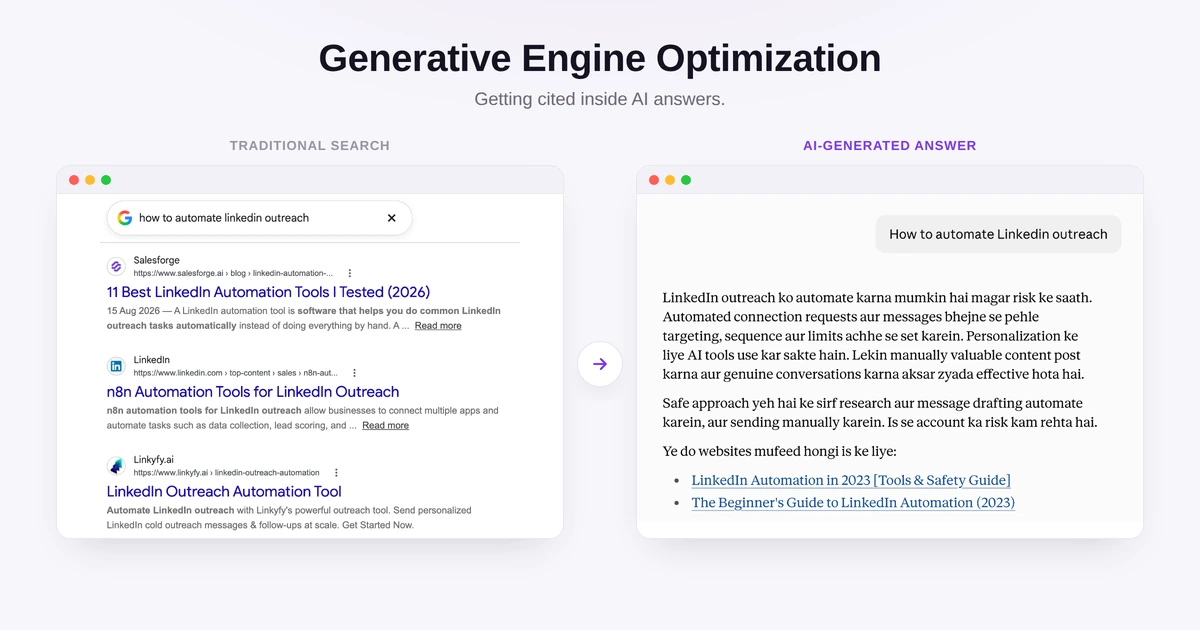
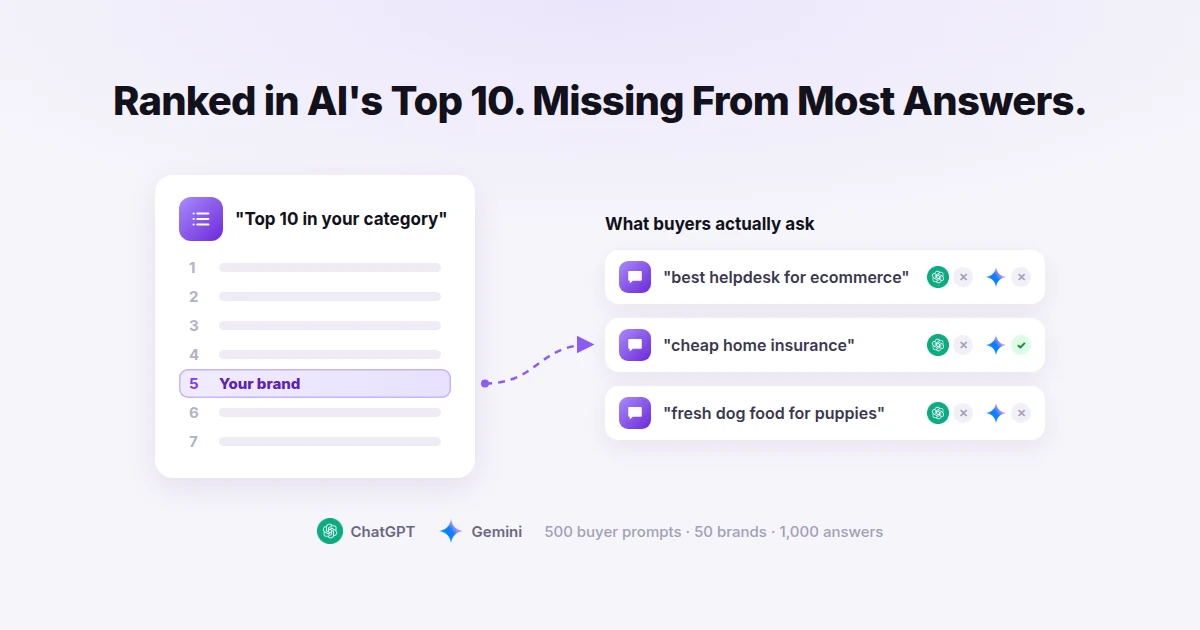
GEO and SEO share one foundation: crawlable pages, clear content and credible sources. They aim at different outcomes. SEO earns a position and a click on a results page, while GEO earns a mention or a citation inside a written answer that the reader may never click past. The gap is easy to measure. In our study of 500 buyer questions, every brand had already been put on its category's top-10 list by both ChatGPT and Gemini. Yet when we asked the questions a real buyer types, ChatGPT named the brand in 31% of its answers and Gemini in 37%. For 52% of the prompts, neither app named the brand.
The comparison below shows where the two disciplines diverge.
Dimension
Traditional SEO
Generative engine optimization (GEO)
Goal
Rank a page higher in the search results
Get the brand mentioned, or a page cited, inside a generated answer
Where results appear
A ranked list of links on a results page
Google AI Overviews and AI Mode, ChatGPT, Perplexity, Gemini and Claude answers
Unit of success
Ranking position and organic clicks
Mention rate, citation rate and share of voice
Main signals
Crawlability, backlinks, on-page relevance
Crawler access, clear entities, quotable facts with sources, third-party mentions
How you measure it
Rank tracking and Search Console clicks
The same prompt set asked across engines on a fixed schedule
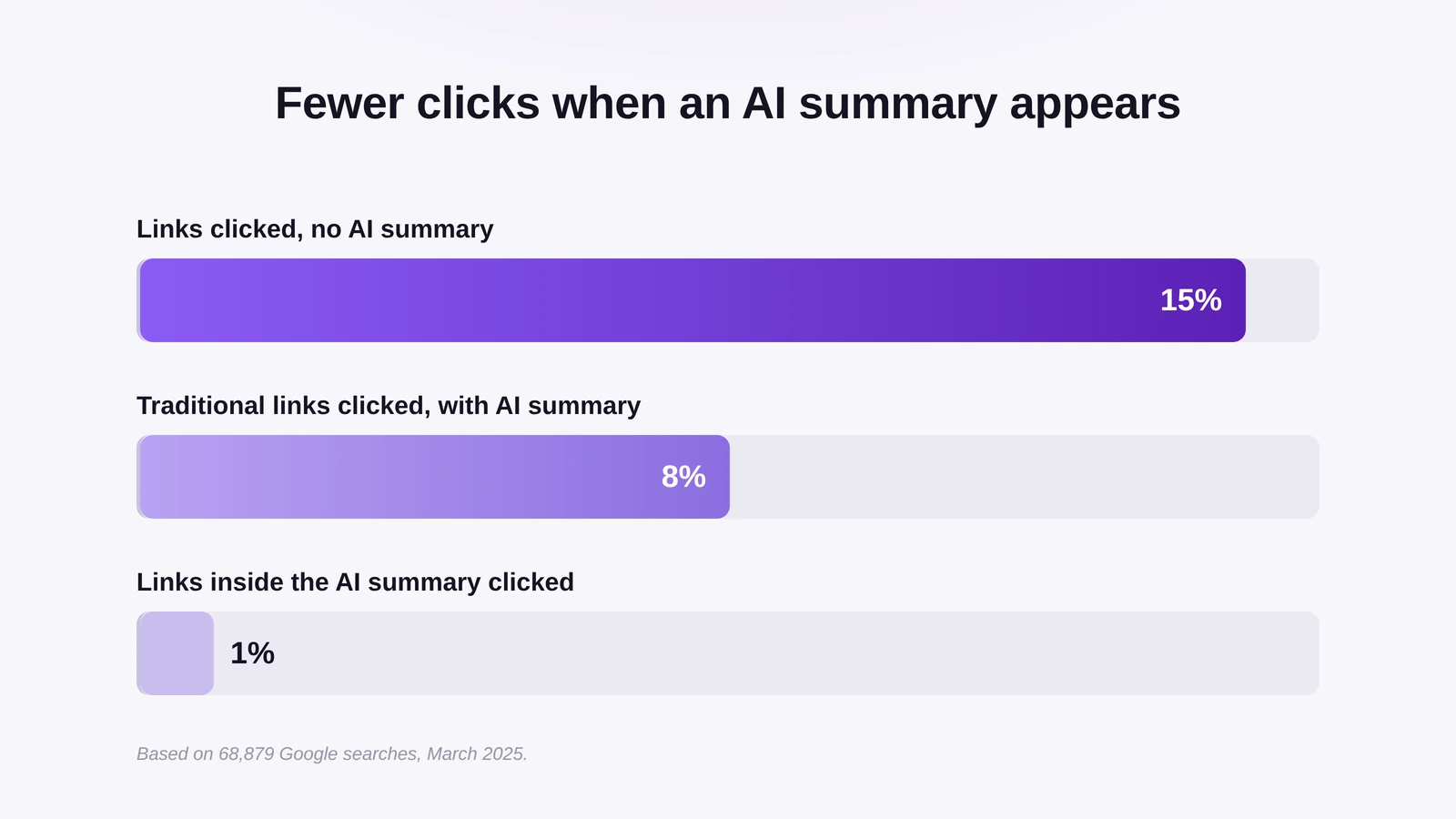
The click gap is real. In Pew Research Center's analysis of 68,879 Google searches from March 2025, people clicked a traditional result in 8% of visits when an AI summary appeared, versus 15% when it did not, and clicked a link inside the summary in just 1% of visits (Pew Research Center, 2025). When fewer people click through, being named inside the answer matters more.
Share of visits with a click, with and without an AI summary. Source: Pew Research Center (2025)
Side by side, with a 90-day plan to start: SEO vs GEO.
How do AI answer engines find and choose sources?
No engine publishes a complete source-selection formula. What each vendor does document is how its crawlers reach your pages and when its answers show sources, and that is where GEO work starts. Access is a requirement, never a promise of a citation.
ChatGPT
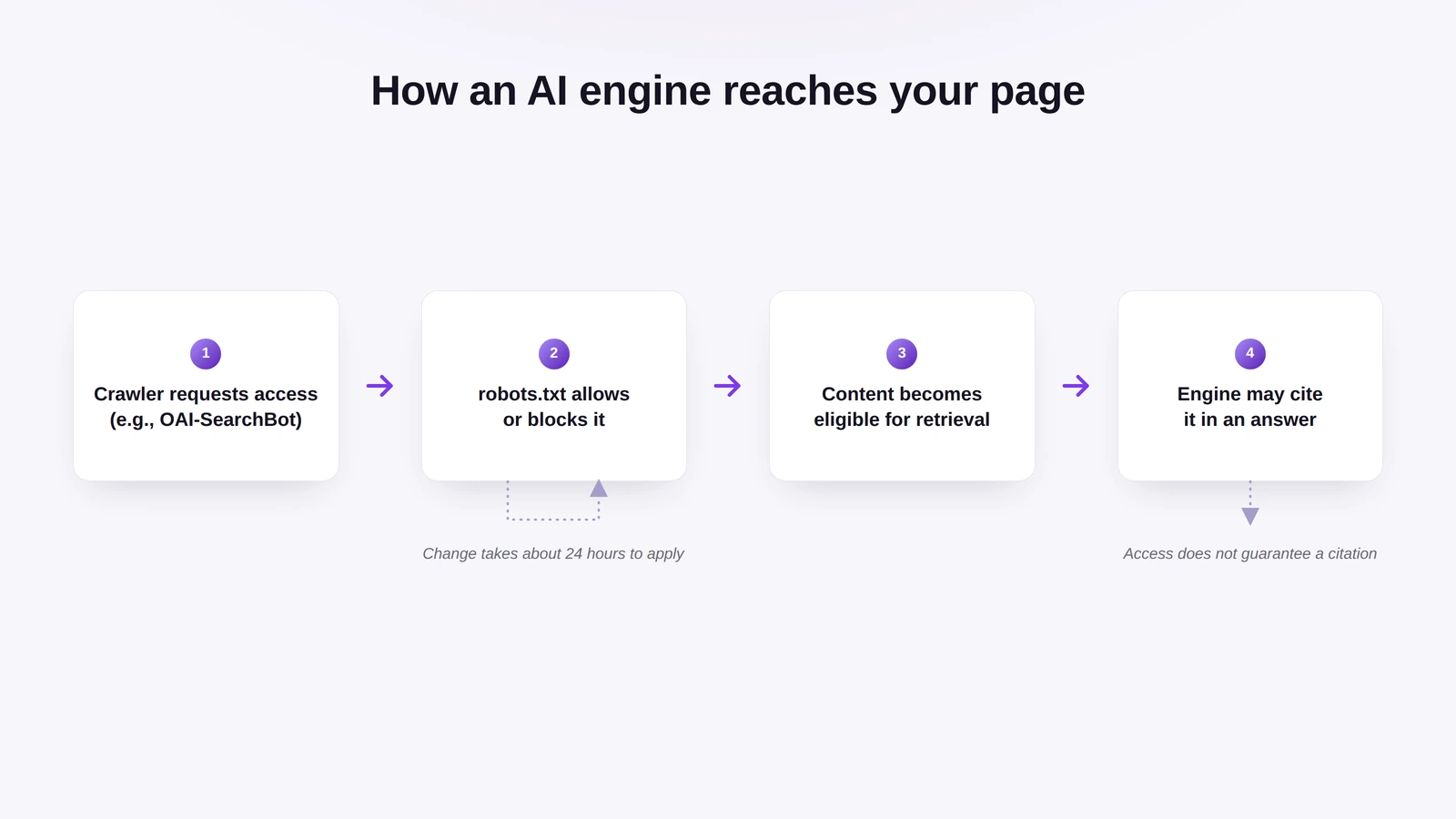
OpenAI runs separate crawlers for search and for training. OAI-SearchBot helps surface websites in ChatGPT search, while GPTBot crawls content that may be used to train foundation models, and site owners can allow one and block the other in robots.txt (OpenAI crawler documentation). OpenAI also says ChatGPT search responses link to their sources and that a robots.txt change can take about 24 hours to apply.
The practical rule: if you want to appear in ChatGPT search, allow OAI-SearchBot. Blocking GPTBot only opts your content out of model training.
Google says AI Overviews and AI Mode may use query fan-out, running several related searches across subtopics, and that a page must be indexed and eligible to show as a Search snippet to qualify as a supporting link, with no guarantee of inclusion (Google Search Central). There is no separate AI crawler to allow: pages come from Google's normal Search index.
A broad question such as "how do I choose accounting software" can fan out into searches about pricing, integrations and compliance. A page that answers one of those subtopics clearly can be used even if it does not rank for the broad question.
Perplexity answers from web search results and links the websites it uses. Its crawler, PerplexityBot, surfaces and links websites in Perplexity search results and is not used to collect content for training AI foundation models (Perplexity crawler documentation). A second agent, Perplexity-User, visits a page when a user's question needs it and generally ignores robots.txt, because a person started the request.
Gemini
The Gemini app sometimes shows its sources and related content within and below a response, and not every response includes links (Gemini Apps Help). Google also offers a separate control, Google-Extended, which decides whether your content can be used to train Gemini models and to ground answers in Gemini apps; Google says it does not affect inclusion in Google Search or act as a ranking signal (Google's crawler documentation).
Claude
Anthropic separates three agents: ClaudeBot for potential model-training data, Claude-SearchBot for improving search results, and Claude-User for fetching pages in response to user requests, and these bots honor robots.txt (Anthropic's crawler guidance). When Claude searches the web, it can run several searches in a row as earlier results point to further research, then answer with citations to its sources (Anthropic's web search announcement).
How do you improve AI visibility? A 6-step GEO optimization playbook
Improving AI visibility means removing the barriers that stop AI systems from finding, understanding and trusting your pages. Work through the steps in order. None of them guarantees a citation, but each one removes a reason for an engine to skip you.
1. Make your entity unmistakable
Name the business, its category, its products and its location in plain language on core pages, not just in a tagline. Avoid vague phrasing like "innovative solutions" that forces a reader, human or machine, to guess what you sell. A 20-person accounting software company should say "accounting software for freelancers" on its homepage, not "financial empowerment tools." Use the same name and description on your site, your Google Business Profile and third-party listings, so every mention points to one entity.
2. Put the direct answer first
Answer each page's core question in its first sentence or two, then add detail. Because AI Overviews and AI Mode fan a question out into related searches (Google Search Central), a short, self-contained answer is easier to match to one of those subqueries and easier to quote.
3. Add statistics, quotations and cited sources
This step has the strongest evidence behind it. In the GEO study, adding quotations, adding statistics and citing sources were among the most effective methods tested, while keyword stuffing, a classic SEO tactic, did not perform well (GEO: Generative Engine Optimization). Name the study, the year and the sample, and attribute quotes to a real person and title rather than "experts say."
4. Keep structured data honest
Google says no special schema.org markup or AI-specific file is required for AI Overviews or AI Mode, and that structured data should match the visible text (Google Search Central). Use Organization, Product, Article and FAQPage markup to describe what is on the page, never to add claims that are not there.
5. Earn mentions on other sites
When an AI answer cites sources, many of them are pages you do not own: reviews, comparison articles, directories and news. Being described accurately and often on those pages gives engines independent sources that confirm what your site says. Treat PR, partnerships and review requests as GEO work, and keep the facts on those pages consistent with your own.
6. Let AI search crawlers in
Check robots.txt, your CDN and your firewall for rules that block OAI-SearchBot, Claude-SearchBot or PerplexityBot. Each vendor lets you allow its search crawler separately from its training crawler (OpenAI, Anthropic, Perplexity docs). Re-check after every site migration, security plugin or CDN change, because one rule can quietly remove you from AI search.
Most lost AI visibility comes from a few avoidable errors, not from a hidden penalty.
Expecting special schema to earn citations: Google says no special markup or AI-specific file is required for AI Overviews or AI Mode (Google Search Central). Markup helps accuracy, not ranking.
Keyword stuffing: It is the classic SEO habit the GEO study found did not perform well, while quotations, statistics and sources did (GEO paper).
Blocking AI search crawlers by accident: A robots.txt rule written for scrapers can block OAI-SearchBot or Claude-SearchBot without anyone noticing.
Treating one citation as proof: Results vary by domain and by query, so one answer on one day is not a trend.
Assuming indexing equals inclusion: A page must be indexed and snippet-eligible to be considered for AI Overviews, and inclusion is still not guaranteed.
How should you measure GEO and AI visibility?
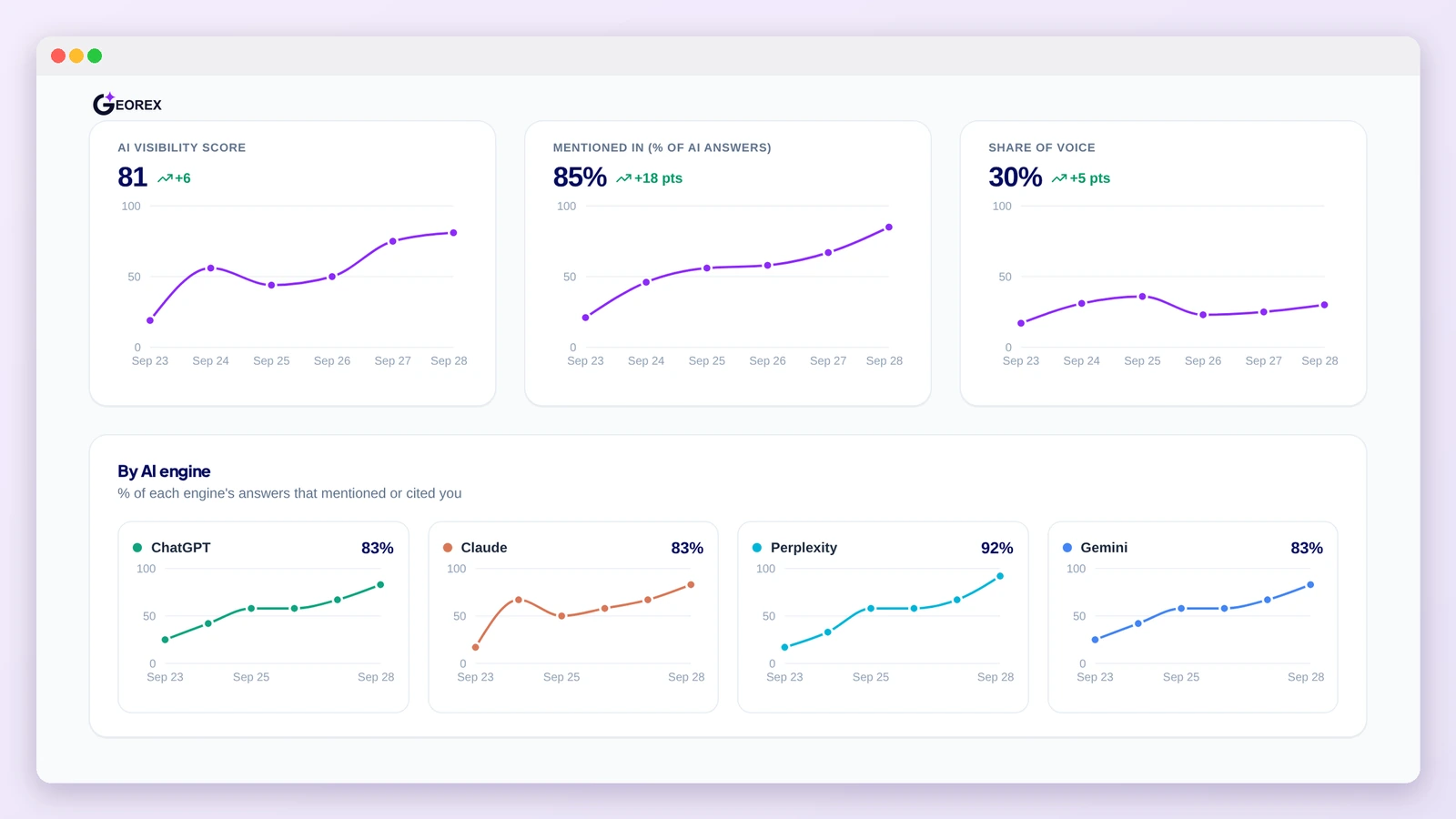
Measuring GEO means asking the same questions on a schedule and comparing the answers over time, not checking once. A useful system tracks four things: mentions, citations, competitors and the traffic that follows.
Example of tracking AI visibility, mentions and share of voice per engine in GEOREX (sample data)
Track mentions and citations separately
A mention is any answer that names your brand, even without a link.
A citation is an answer that links to one of your pages as a source.
Log both rates by engine and by month; a brand can be mentioned often but cited rarely, or the reverse.
Share of voice compares your mentions with those of the competitors you track, so it shows who AI recommends instead of you.
Use a stable prompt set
Build a fixed list of prompts from real buyer questions, for example 50 prompts for a 20-person software company.
Ask the identical wording on every engine on a fixed cadence, weekly or monthly, so changes reflect the engines, not your wording.
Add new prompts in dated batches so trends stay comparable.
Doing this by hand stops scaling after a few dozen prompts. Tools such as GEOREX AI automate it: it asks ChatGPT, Gemini, Google AI Overviews, Perplexity and Claude the prompts your buyers ask and reports mentions, citations and share of voice per engine and per prompt.
Record competitors and cited URLs
Note which competitors appear alongside or instead of you for each prompt.
Record the exact URL that was cited, not just the domain, to see which pages and formats get picked.
Connect visibility to traffic
In Google Search Console, clicks from AI features are counted inside the Web search type of the Performance report, not in a separate report (Google Search Central).
In your analytics, watch referral sessions from chatgpt.com, perplexity.ai and gemini.google.com.
Expect fewer clicks per appearance than classic search: Pew found that only 1% of visits clicked a link inside Google's AI summary (Pew Research Center).
GEO can move within weeks for pages that are already indexed and cited, while a new site or a brand with few third-party mentions usually needs several months. Engines have to recrawl a page before a change counts: Google notes that changes to a page's search preview controls can take from several days to several months to be recrawled and processed (Google Search Central), and OpenAI says a robots.txt change for ChatGPT search takes about 24 hours to apply (OpenAI crawler documentation).
Plan in quarters. Fix crawler access and entity details in the first month, rewrite your most important pages answer-first in the second, keep earning third-party mentions throughout, and measure every month against the same prompt set.
It is the same thing as generative engine optimization (GEO). "GEO optimization" is simply how many people search for it. The work is the same: let AI search crawlers in, answer questions directly, back claims with sourced numbers, earn mentions on other sites, and track a fixed prompt set.
No. Google says no special schema.org markup or AI-specific file is required for AI Overviews or AI Mode. Any structured data you add should match the visible content of the page, according to Google Search Central.
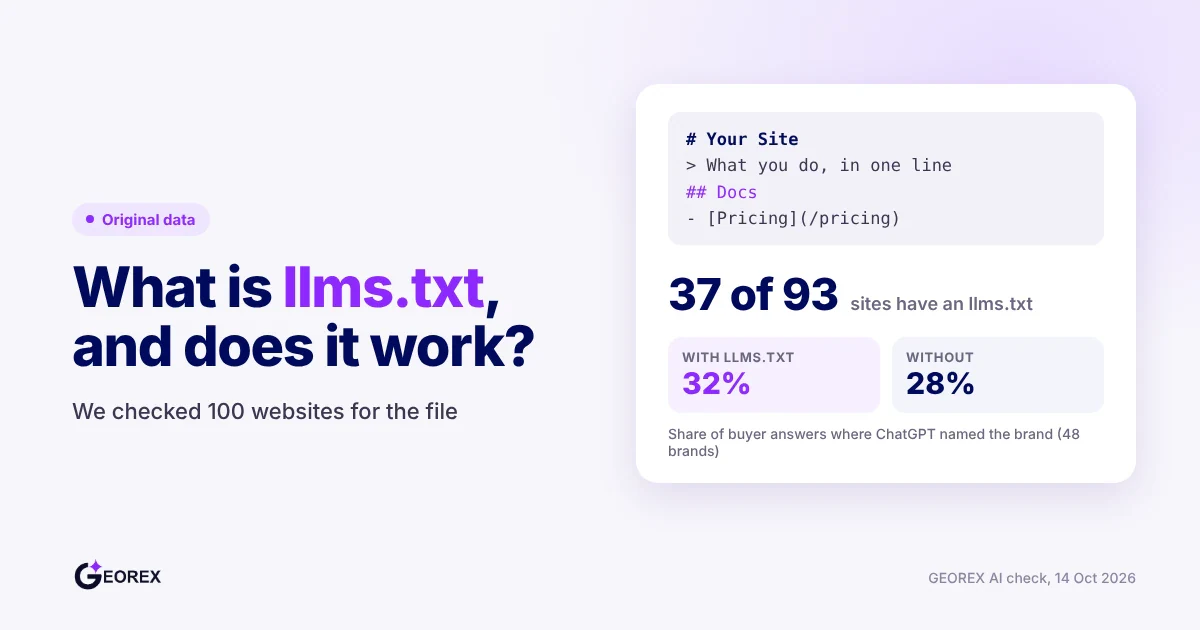
There is no evidence that it does. Google says AI-specific files are not required for AI Overviews or AI Mode, and no major AI search engine documents using llms.txt to choose the sources it cites, so treat it as optional and unproven.
Allow the search crawlers if you want to be cited: OAI-SearchBot for ChatGPT search, Claude-SearchBot for Claude and PerplexityBot for Perplexity. You can still block training crawlers such as GPTBot and ClaudeBot, because OpenAI and Anthropic treat search and training separately.
No. Google-Extended controls whether your content is used to train Gemini models and to ground Gemini apps. Google says it does not affect inclusion in Google Search or act as a ranking signal, and AI Overviews draw on pages in the normal Search index.
Yes. Pew Research Center's analysis of 68,879 Google searches from March 2025 found that traditional results were clicked in 8% of visits with an AI summary versus 15% without one, and links inside the summary in just 1% of visits.
No. The 2024 GEO study found that keyword stuffing, a traditional SEO tactic, did not perform well, while adding quotations, statistics and cited sources improved visibility in AI answers the most, by up to 40%.