How to Measure AI Visibility: Mentions, Citations and Share of Voice
M. Zeeshan, Founder of GEOREX AI
Generative Engine & AI Search Intelligence
Share:
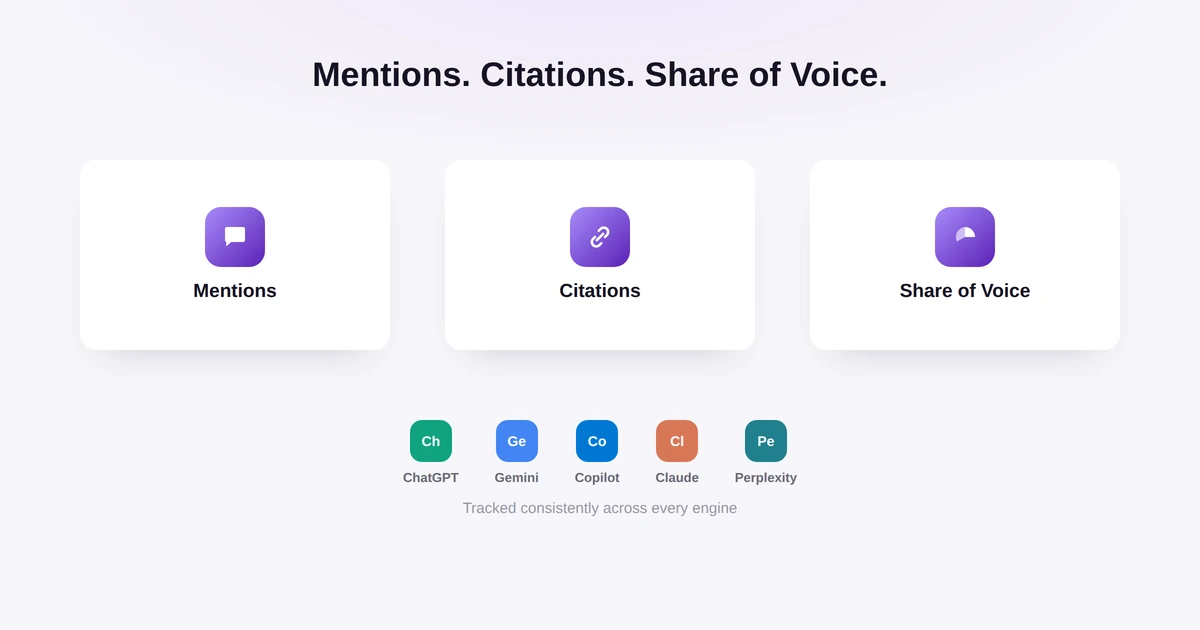
"AI visibility is how often AI engines name or cite your brand when buyers ask questions about your category. Measure it with three numbers, each counted per answer: mention rate (answers that mention you ÷ answers checked), citation rate (answers that show your website ÷ answers checked) and AI share of voice (your mentions ÷ all tracked brands' mentions)."
Key takeaways
Mentions, citations and AI share of voice measure three different things. Report them side by side and never average them into one score.
One answer is one prompt asked to one AI engine. Keep that unit fixed so every rate has a clear denominator.
Pew Research Center found users clicked a traditional search result in 8% of visits when an AI summary appeared, versus 15% when none did.
Conductor found that for purchase-intent prompts, only four of every ten distinct brands named across two runs appeared in both.
Start with a fixed set of real buyer questions across the funnel (40 to 60 is a practical starting point), lock the wording and rerun it unchanged every cycle.
GA4's default AI Assistant channel leaves out Google AI Overviews and AI Mode; measure those in Search Console instead.
What does AI visibility mean for a B2B or SaaS brand?
AI visibility measures how often an AI engine names, describes or links to a brand when someone asks a buying-related question. For a B2B or SaaS company, it breaks into three signals: mentions, citations and share of voice against the competitors buyers actually compare you with. It sits inside the wider practice of .
M. Zeeshan, Founder of GEOREX AI
Author
Founder of GEOREX AI, an AI visibility platform that tracks how brands actually appear across ChatGPT, Claude, Perplexity, and Gemini, and turns the gaps it finds into a prioritized action plan.
Boost Your Brand in Generative Search
Turn AI engines into your highest-converting acquisition channel.
GEOREX monitors how ChatGPT, Gemini, Google AI Overviews, Perplexity, and Claude cite your brand across thousands of real buyer queries and provides actionable optimization playbooks.
A mention means the answer names the brand, writes its website, or lists the website among the engine's sources, whether the engine recommends the brand, compares it or simply lists it. A citation is narrower: the brand's website appears in the answer text or in the engine's linked sources.
An answer can name a brand without citing its site, and it can cite a page without praising the brand in the prose. Treating these as one number hides the gap between them. A SaaS company that is named in 40% of tracked answers but cited in only a few of them has a different problem from one that is cited often but rarely recommended by name. Which engines tend to name which brands, and why, is covered in how ChatGPT decides which brands to recommend.
Share of voice adds the competitive layer. A high mention rate on its own tells a marketing team little; the useful question is whether the brand shows up more or less often than the three or four companies buyers are weighing it against.
Is AI visibility the same as website traffic?
No. Being mentioned or cited by an AI engine does not guarantee a visit. Pew Research Center analyzed 68,879 Google searches made in March 2025 and found users clicked a traditional search result in 8% of visits when an AI summary appeared, compared with 15% when it did not (Pew, July 2025). Clicks on the source links inside those summaries happened in just 1% of visits to pages with a summary.
So a brand can be named and cited often while referral sessions in analytics stay flat. That is not a measurement failure; it is why presence and clicks need separate numbers.
How do you calculate mention rate, citation rate and AI share of voice?
Score each answer (one prompt asked to one engine) for two things: does it mention the brand, and does it show the brand's website? Then count mentions for every tracked competitor in the same answers. The three metrics come straight from those counts.
Metric
Formula
What it tells you
When to use it
Mention rate
Answers that mention your brand ÷ answers checked. An answer counts when it names your brand, writes your website, or lists your website in its sources.
How often you are part of the answer at all.
Your headline presence number, per engine and per prompt group.
Citation rate
Answers that show your website, in the text or in the engine's sources ÷ answers checked.
How often the engine attributes information to your site, which is what can send a visit.
To judge whether your pages are trusted as sources, not just whether your name is known.
AI share of voice
Your mentions ÷ (your mentions + all tracked competitors' mentions).
Your share of the conversation against named rivals.
To compare competitive position on the same prompts and engines. Keep the competitor set the same between periods.
Worked example
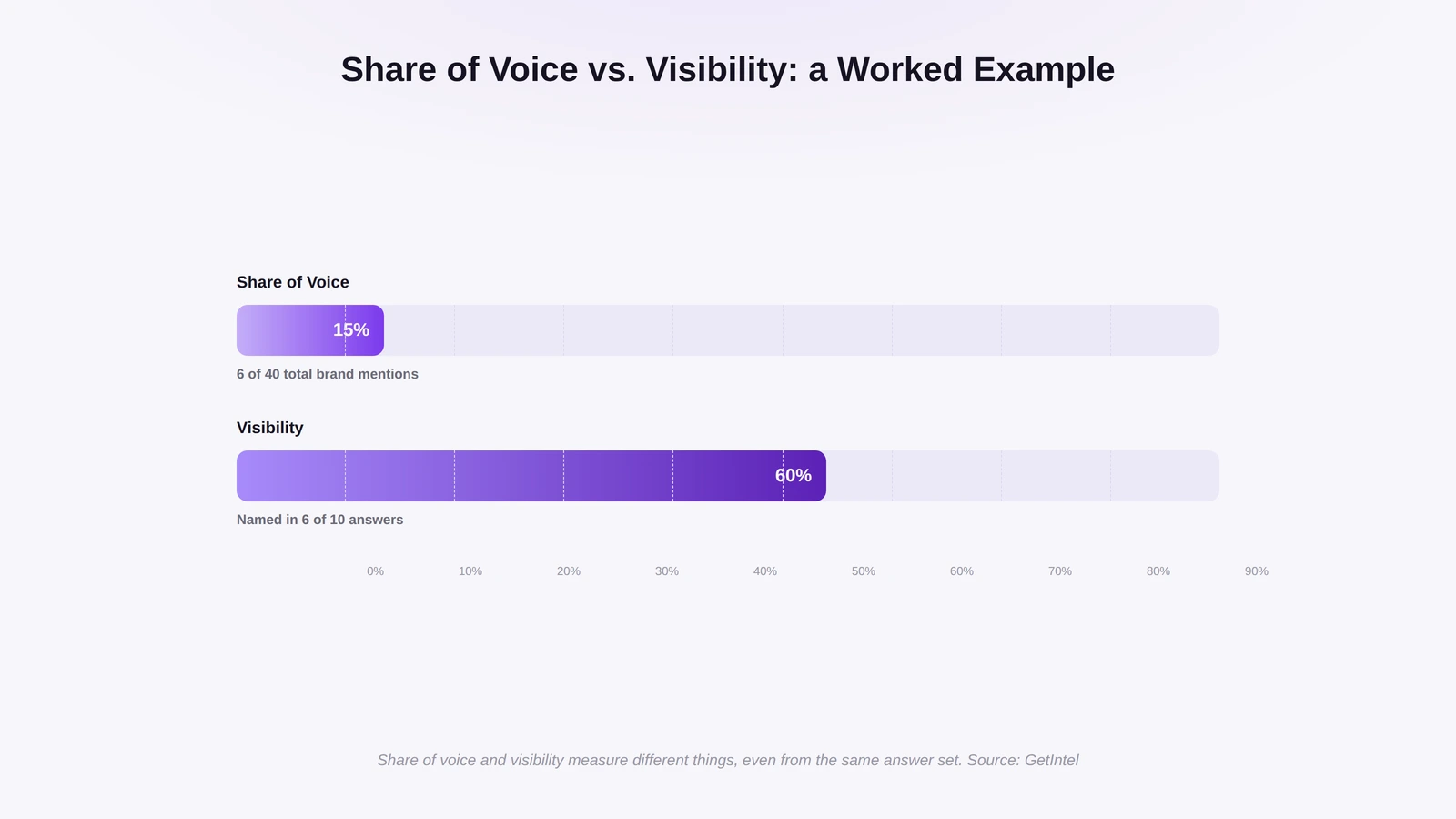
Say you check 10 answers. Your brand is mentioned in 6 of them, your website is shown in 4, and across the same 10 answers your brand and your tracked competitors are mentioned 40 times in total.
Mention rate: 6 ÷ 10 = 60%
Citation rate: 4 ÷ 10 = 40%
AI share of voice: 6 ÷ 40 = 15%
Same answers, two different numbers: visibility and share of voice
A 60% mention rate looks strong, but a 15% share of voice shows that competitors take most of the conversation. That is why the two should never be read as the same thing. If you combine engines or prompt groups, report the combined figure next to the per-engine rates, not instead of them. Referral visits and UTM parameters belong to traffic attribution, not to these answer-level denominators.
If you are deciding how much of this to take on next to SEO, see GEO vs SEO.
How do you build a prompt set around real buyer questions?
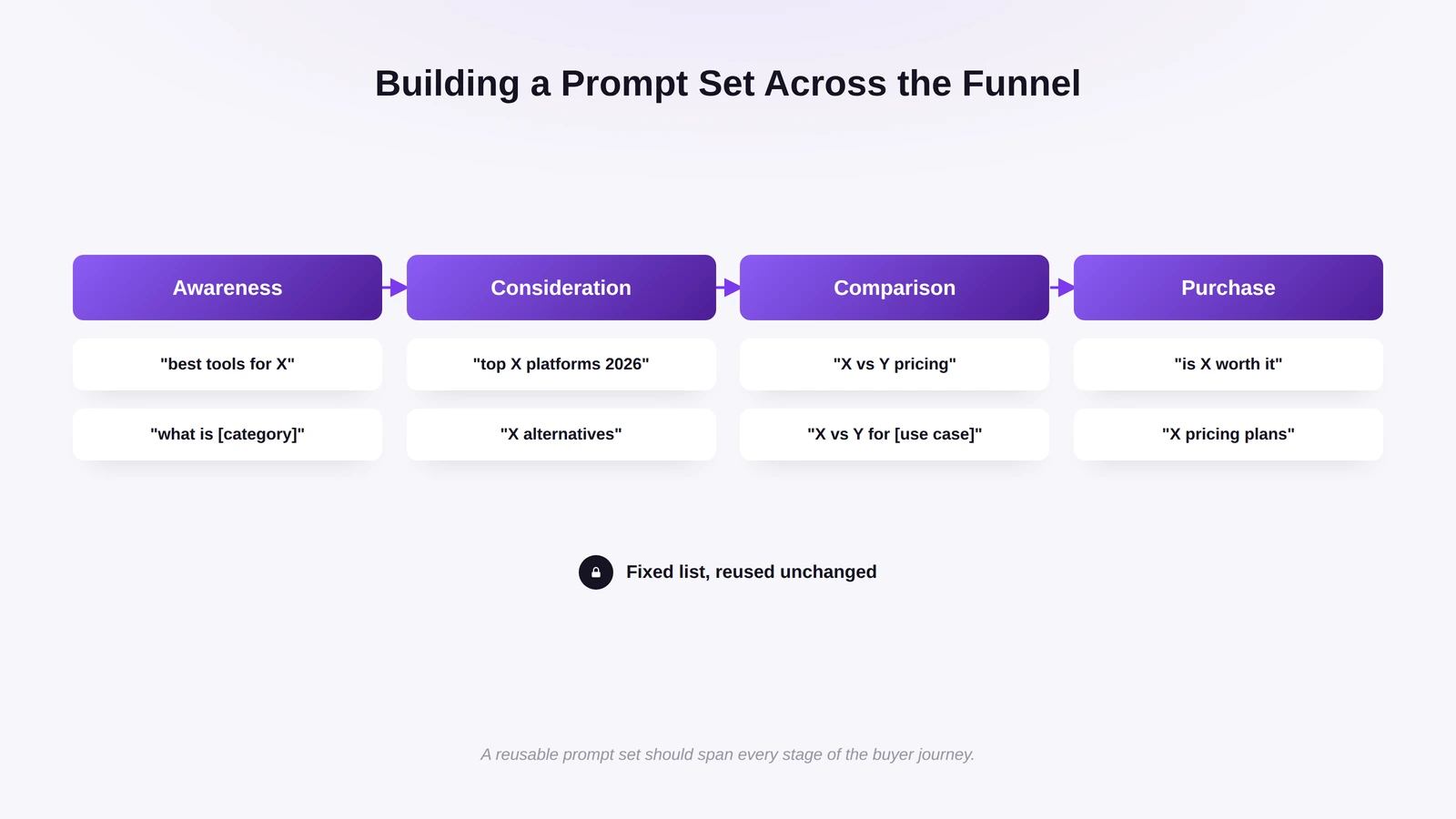
A prompt set is a fixed list of real buyer questions that you run against each AI engine on a schedule, instead of ad hoc checks. Build it once, cover every funnel stage, and reuse it unchanged so results stay comparable over time.
A fixed prompt set that covers the whole buying journey
Cover the buying journey
Top of funnel: problem language buyers use before they know your category exists, such as "how do I reduce support ticket volume" rather than a product name.
Middle of funnel: comparison and evaluation questions, the "best X for a team of Y" or "X vs Y" questions that produce vendor shortlists.
Bottom of funnel: questions about specific vendors, pricing tiers, integrations or implementation concerns, where a missing citation can cost a deal.
Take the wording from sales call notes, support tickets, review sites and win-loss interviews rather than guessing at phrasing.
Make the set large enough to show patterns rather than one lucky or unlucky answer. For many B2B teams, 40 to 60 prompts split across the three stages is a practical start.
Keep the prompt set comparable
Lock the exact wording of each prompt once it is approved; small phrasing changes can change which sources an engine pulls from.
Run the identical list on every engine your buyers use, commonly ChatGPT, Gemini, Perplexity and Claude, so gaps show up by engine rather than by question.
Keep the list in a shared document with a version number, so everyone reports from the same baseline.
Retire or replace prompts only at a scheduled review, never mid-cycle, and log the change so trend lines stay readable.
How do you measure brand visibility consistently across AI engines?
Ask the same prompt set to each engine on a set schedule, log every answer, and treat any single check as a snapshot, not a verdict. Because answers shift between runs, a mention rate or citation rate only becomes meaningful when it is averaged over repeated checks.
Why does each prompt need repeated runs?
AI answers vary between repeated runs of an identical prompt. Conductor's 2026 study made 14,000 API calls across 10 industries, seven prompt-intent types and four large language models, with 50 runs per combination, to measure that variation (AI recommendation consistency study). For purchase-intent prompts, only four of every 10 distinct brands named across two separate runs appeared in both. A brand can appear in one run and disappear in the next with nothing changed on its side.
In practice, run each prompt several times per engine per reporting period. Five to ten runs is a reasonable middle ground between stable numbers and query cost; fewer runs risk mistaking noise for a trend. Keep prompt wording, account type, location and language settings fixed, so a change in mention rate reflects a real shift in how ChatGPT, Gemini, Google AI Overviews, Perplexity or Claude answer, not a change in how you asked. Tools such as GEOREX AI run this for you, measuring mentions, citations and share of voice per prompt and per engine across all five.
How do you track AI-assistant referral traffic in GA4?
GA4 can separate visits that arrive from AI assistants, but only Google's default channel or a custom channel will catch them. This gives you the other half of the picture: real visits, not just presence in an answer.
Build an AI-assistant channel
Check your default channel group first. Google Analytics defines an AI Assistant channel for sources such as ChatGPT, Gemini, DeepSeek, Copilot and Grok (Google Analytics Help).
Note what it leaves out: Google AI Overviews and AI Mode are not part of the AI Assistant channel.
Add a custom channel for anything the default misses. Google documents a custom channel built on a source-matching regular expression for assistants such as ChatGPT, Gemini, Copilot, Claude and Perplexity (Google Analytics Help).
Place that custom channel above Referral in the channel order, as Google advises, so these sessions are not counted as generic referral traffic.
Review the channel monthly. New assistants launch often, and an unlisted source falls back into Referral or Direct until you add it.
Keep visits and visibility apart
A rise in AI-assistant sessions means people clicked through, not that you were mentioned more. A company can hold a steady mention rate across 50 tracked prompts while referral sessions stay flat for weeks, because many answers carry no link at all. Report the two numbers side by side and never substitute one for the other.
Where do you measure Google AI Overviews in Search Console?
Search Console has a generative AI performance report for AI Overviews and AI Mode, and its data is included in the Web search type of the Performance report rather than kept in a separate dashboard (Search Console Help).
Open Search Console and go to the Performance report.
Open the generative AI performance view within the Web search type.
Check impressions for the queries and pages you track; the report records how often a page appeared in an AI Overview or AI Mode result.
Filter by page or query to see which URLs appear for the questions in your prompt set.
Read these impressions next to clicks for the same queries. A page with many AI impressions and few clicks is being seen and used as a source, which is exactly the gap the Pew figures describe. For what makes a page eligible to be cited there in the first place, see how to get cited in Google AI Overviews.
How should you report AI visibility, and which mistakes should you avoid?
Report mention rate, citation rate and share of voice on a fixed schedule, not whenever someone asks. Monthly works for most B2B and SaaS teams; fast-moving categories or active campaigns may justify every two weeks.
Reporting checklist
Rerun the same prompt set every cycle: same engines, same wording.
Report mention rate, citation rate and share of voice separately.
Track every competitor buyers actually compare you with, not just the obvious two or three.
Show engine-by-engine results instead of one blended number.
Label results from a small prompt set (under 20 to 30 prompts) as directional, not conclusive.
Common mistakes
Treating a screenshot of one good answer as proof of visibility.
Counting mentions while ignoring whether your site was actually cited.
Dropping a competitor from tracking once it stops winning, which quietly inflates your share of voice.
Comparing this month's AI Overview clicks with last month's ChatGPT referrals as if they measured the same thing.
Yes, and it should report them separately. A mention means the brand is named (or its website appears) in the answer; a citation means its website is shown as a source. A brand can be mentioned without being cited, or cited without being recommended in the text, so one blended number hides the difference.
How to Get Your Content Cited in Google AI Overviews
What makes a page eligible for Google AI Overviews and AI Mode, how query fan-out picks sources, which snippet controls matter, and how to measure citations and clicks.