How ChatGPT Decides Which Brands to Recommend (and How to Get Recommended)
M. Zeeshan, Founder of GEOREX AI
Generative Engine & AI Search Intelligence
Share:
"ChatGPT recommends brands either from patterns learned during training or from live web pages it retrieves and cites through ChatGPT Search, and only the second path leaves a citation trail. A brand improves its odds by keeping its facts clear and consistent across the web and by letting OpenAI's search crawler reach its pages."
Key takeaways
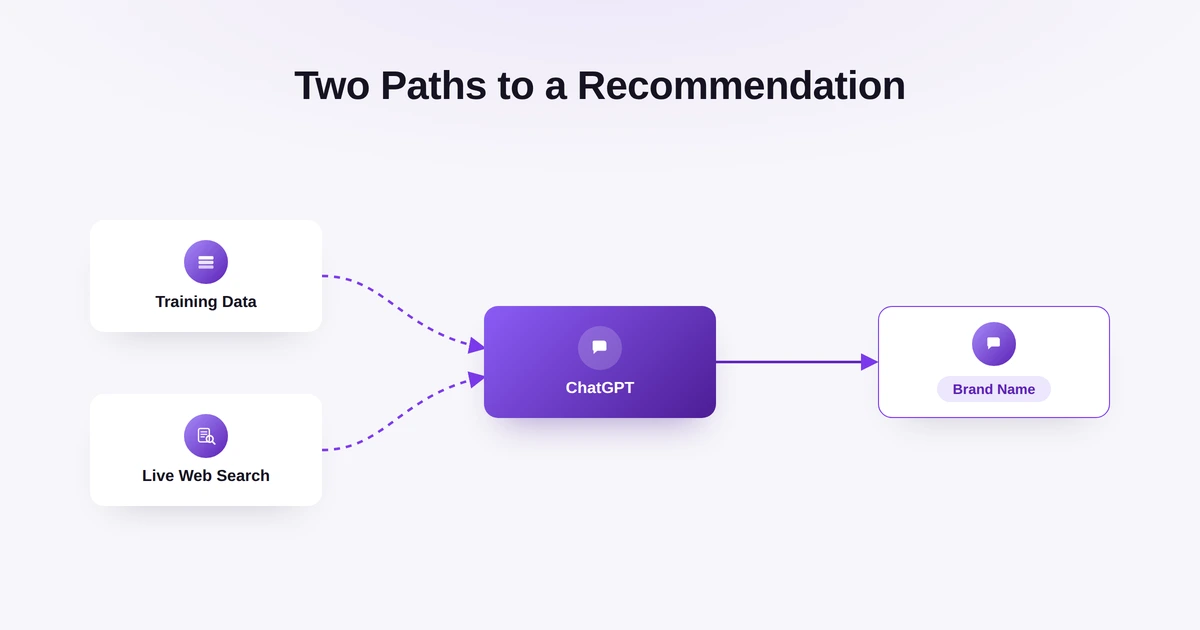
ChatGPT names brands either from patterns learned in training or from web pages it retrieves and cites through ChatGPT Search; only the second path leaves a citation you can see and influence.
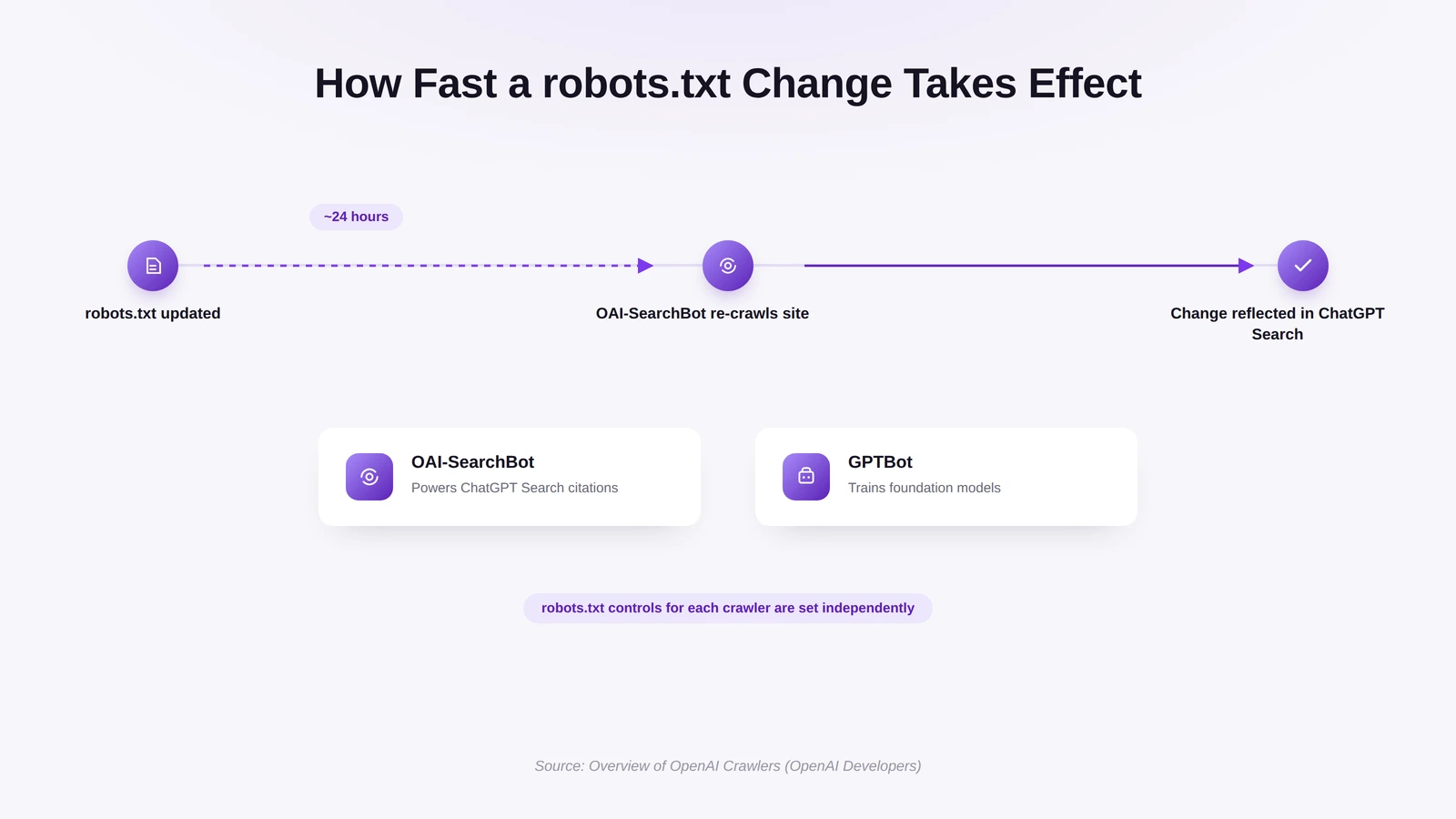
OAI-SearchBot decides whether your pages can appear in ChatGPT Search; GPTBot only controls model training, and each has its own robots.txt rule.
OpenAI documents crawling, citations and shopping feeds, but not a ranking formula for which brand gets named.
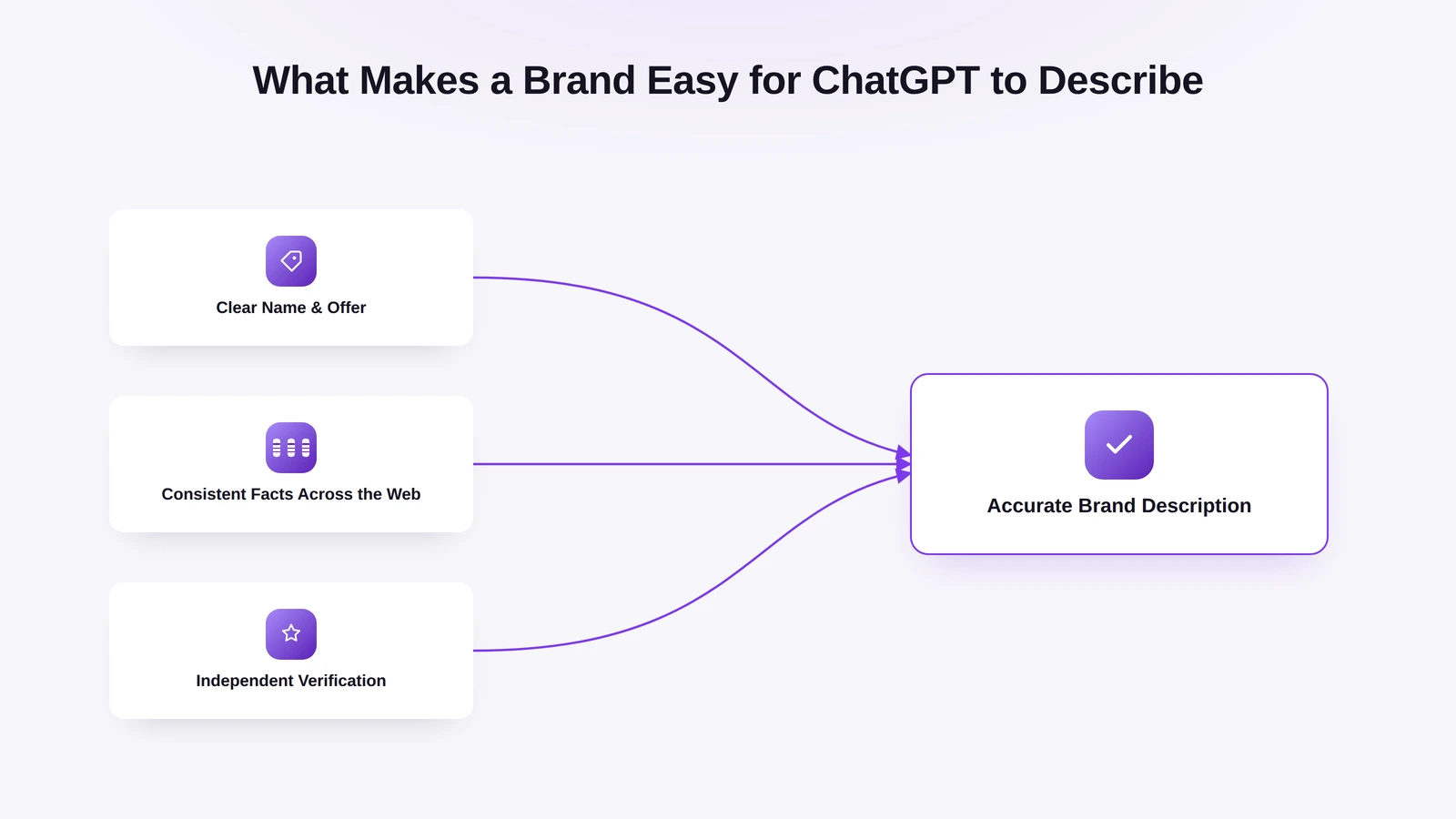
Clear, consistent facts on your site and on independent sites make a brand easier for ChatGPT to describe accurately.
Measure it like an experiment: the same buyer questions on a schedule, logging mentions, citations and competitors separately.
How does ChatGPT form brand recommendations, from training or search?
ChatGPT names brands in two distinct ways: it can draw on patterns learned during training, or on web pages it retrieves and cites through ChatGPT Search when someone asks a question. Which path runs depends on the question, the mode and whether current information is needed. The distinction matters because only the search path leaves a citation trail a brand can observe and influence. For the wider discipline behind this, see our guide to .
M. Zeeshan, Founder of GEOREX AI
Author
Founder of GEOREX AI, an AI visibility platform that tracks how brands actually appear across ChatGPT, Claude, Perplexity, and Gemini, and turns the gaps it finds into a prioritized action plan.
Boost Your Brand in Generative Search
Turn AI engines into your highest-converting acquisition channel.
GEOREX monitors how ChatGPT, Gemini, Google AI Overviews, Perplexity, and Claude cite your brand across thousands of real buyer queries and provides actionable optimization playbooks.
Learned-knowledge answers come from patterns baked into the model during training, not from a live lookup. A brand that was widely discussed, reviewed and compared on the web before the training cutoff has a better chance of surfacing. This mode produces no citations and no fresh data: it reflects how a brand was talked about then, not how it looks today. A company that launched last year may barely appear in this mode simply because it did not exist in the training data.
Recommendations informed by live search
Live-search answers happen when ChatGPT retrieves current web pages and cites them in the response. OpenAI documents that OAI-SearchBot is the crawler that surfaces sites in ChatGPT Search, and that blocking it in robots.txt removes a site from search answers (OpenAI crawler documentation). This mode favors whatever is indexable and current right now, so a brand's visibility can shift as its pages change or as competitors publish.
What OpenAI documents, and what it does not
OpenAI documents the mechanics of crawling and citation, not a ranking formula for why one brand gets named over another. Any claim about exact ranking signals is practitioner inference, not documented fact, and the rest of this guide labels it that way.
When does ChatGPT Search retrieve and cite web pages?
ChatGPT Search can only cite a page that OAI-SearchBot is allowed to reach. If a site blocks OAI-SearchBot, OpenAI says the site drops out of ChatGPT Search answers, which means no citation and no mention sourced from that page.
Each OpenAI crawler is controlled separately in robots.txt. Source: OpenAI
OAI-SearchBot, GPTBot and ChatGPT-User serve different purposes, and each has its own robots.txt setting. GPTBot crawls content that may be used to train OpenAI's foundation models, separate from anything related to search citations. ChatGPT-User visits a page only in response to a user action inside ChatGPT, is not an automatic crawler, and does not decide whether a site can appear in ChatGPT Search (OpenAI's crawler page). A brand can block GPTBot to opt out of model training while still allowing OAI-SearchBot, keeping its pages eligible for citations. OpenAI notes that a robots.txt change takes about 24 hours to apply.
How to inspect cited sources
Open a ChatGPT answer that includes citations and look at the source markers attached to specific claims. Click through each one to confirm the page actually supports what ChatGPT attributed to it, because a citation points to a source but does not guarantee the summary is complete. For your own research, this also shows whether competitor pages, review sites or shopping results are being cited instead of you.
What can a brand publish to improve its chances of being named?
A brand is easier for ChatGPT to describe accurately when its name, offer and facts are stated clearly and consistently across the web, and when independent sources back up what the brand says about itself. None of the steps below are confirmed ChatGPT ranking factors; they are practitioner habits that make a brand easier to understand and verify.
Make the brand and its offer clear
State what the company sells in plain language on the homepage, not just a tagline.
Name the product category explicitly, for example "appointment scheduling software" rather than "the smarter way to manage your day".
Use the same company name, product names and spelling everywhere: website, app stores, social profiles and press mentions.
Avoid marketing phrasing that forces a reader, or a model, to guess what the product does.
Keep key facts consistent across credible sources
Check that founding year, headquarters, pricing model and core features match across your site, Wikidata (if you have an entry), Crunchbase, LinkedIn and the major directories in your category.
Fix contradictions between an old press release and the current site; outdated claims linger in indexed pages.
Ask partners, resellers and industry directories to update stale descriptions of your product.
Treat this as ongoing maintenance, because listings drift as the product changes.
Support claims with evidence and independent coverage
Publish comparison pages that name real alternatives and describe trade-offs honestly, including where a competitor is the better fit.
Back your claims with statistics, quotations and cited sources: in the GEO study, these were among the methods that improved visibility in AI answers the most, by up to 40% (GEO: Generative Engine Optimization).
Welcome coverage in third-party reviews and comparisons on sites you do not control; independent write-ups carry weight that self-published claims cannot.
Never pay for reviews or ask staff to post as customers; manipulated reviews damage credibility once discovered.
Keep product, pricing and availability current
Update pricing pages the moment a plan changes, and remove discontinued tiers instead of leaving them live.
State availability clearly: regions served, platforms supported and whether a free trial exists.
Refresh documentation and FAQ pages when a feature changes, since outdated specs create contradictions that make any source harder to trust.
Audit pricing, feature lists and comparison pages for drift every quarter.
A useful test: imagine a careful analyst trying to summarize your brand in two sentences using only what is public. If that analyst would struggle to find a clear, consistent answer, a language model will likely struggle too.
How do product feeds affect ChatGPT shopping recommendations?
OpenAI's commerce documentation sets specific requirements for the product feeds behind shopping results in ChatGPT, which is a separate path from how the model names brands in a text answer (OpenAI commerce documentation). A merchant who wants to appear in shopping results should treat the feed as a structured-data job, not a copywriting job.
Feed details OpenAI calls for
OpenAI's guidance lists the fields a merchant feed needs and how often it should refresh:
Feed element
What OpenAI's documentation asks for
Identifiers
Unique IDs for each product and variant
Descriptions
Clear, accurate product descriptions
Prices
Current, correct price data
Inventory
Stock and availability status
Media
Product images and other rich media
Fulfillment options
Shipping and delivery details
Update frequency
Daily snapshots of the feed
Missing or stale fields can keep a product out of shopping results, because the feed is what ChatGPT reads for that purpose.
Recommended attributes and their stated value
OpenAI names rich media, reviews and performance signals as recommended attributes that improve ranking, relevance and trust in shopping results (OpenAI's key concepts page). Unlike the baseline fields, they are optional. For most merchants the practical levers are images and reviews, because performance signals such as sales take time to build.
Why might ChatGPT recommend different brands across prompts or runs?
ChatGPT can name different brands for what feels like the same question, because small changes in wording, timing or context change which learned patterns or search results it draws on. A single response is a sample, not a stable score.
Separate prompt wording from measurement noise
Phrasing changes outputs more than most marketers expect. "Best CRM for a small team" and "CRM recommendations for a 10-person startup" can draw on different associations or trigger different searches, producing different brand lists. Earlier messages in the same conversation shape later answers, and two people running the identical prompt can still get different brands or a different order. Before concluding that a brand lost visibility, test several close variations of the question and run each more than once.
Record search, context and response details
Treat each test as a logged observation, not a verdict. For every prompt, note the exact wording, whether the answer cited web sources or answered from memory, which brands appeared and in what order. A pattern across many runs and phrasings tells you far more than any single favorable or unfavorable answer.
What should a brand do to improve its chances of being recommended?
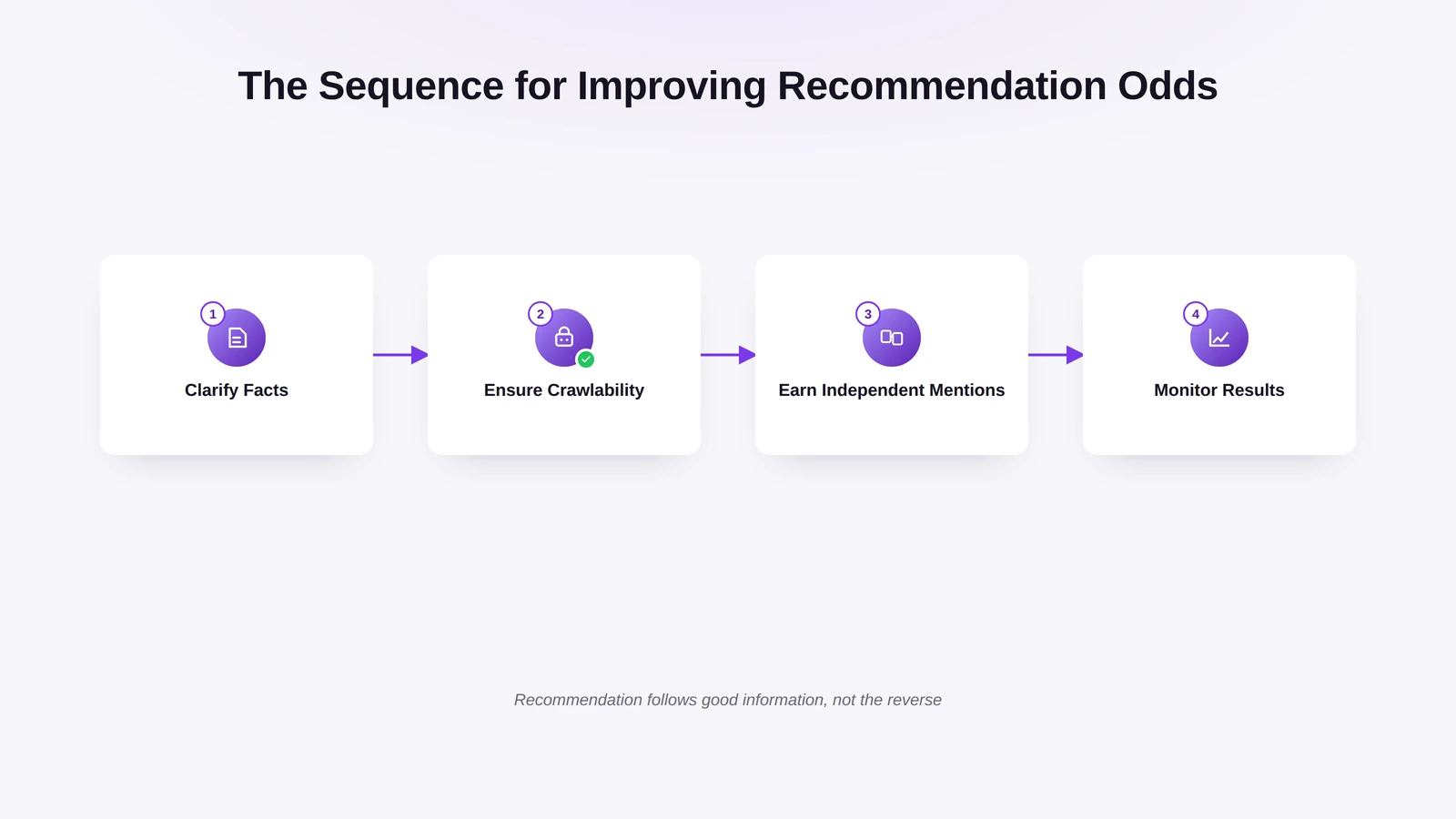
A brand improves its odds by making its facts clear and consistent, then making sure ChatGPT Search can reach them. The sequence below treats a recommendation as a byproduct of good information, not something to engineer directly.
1. Audit what buyers ask
List the 15 to 30 questions real buyers ask ChatGPT before choosing a vendor, including comparison and "best for" phrasing. Run each one and note whether your brand appears, which pages are cited and which competitors show up instead. Flag the gaps where a competitor's product or pricing page is cited and yours is missing or outdated.
2. Fix core pages and product information
Rewrite product and pricing pages so the core facts (what the product does, who it is for, what it costs) sit in plain text near the top, not in PDFs or images. Make your company name, category and claims match across your site, review platforms and directories. Add comparison and use-case pages that answer the exact questions from step 1, and if you sell products, keep your feed data complete and current.
3. Make the right pages reachable
Confirm that robots.txt allows OAI-SearchBot on the pages you want surfaced, and decide separately whether GPTBot may crawl for training (OpenAI). Check your CDN and firewall too, then wait about a day before re-testing a change.
4. Re-test and adjust
Re-run the same questions every few weeks and compare mention and citation rates over time. Treat any single answer as noise, and avoid shortcuts such as fake reviews, hidden text or prompt manipulation, which risk your reputation and do not match how search retrieval or product feeds are documented to work.
How can you test whether ChatGPT recommends your brand?
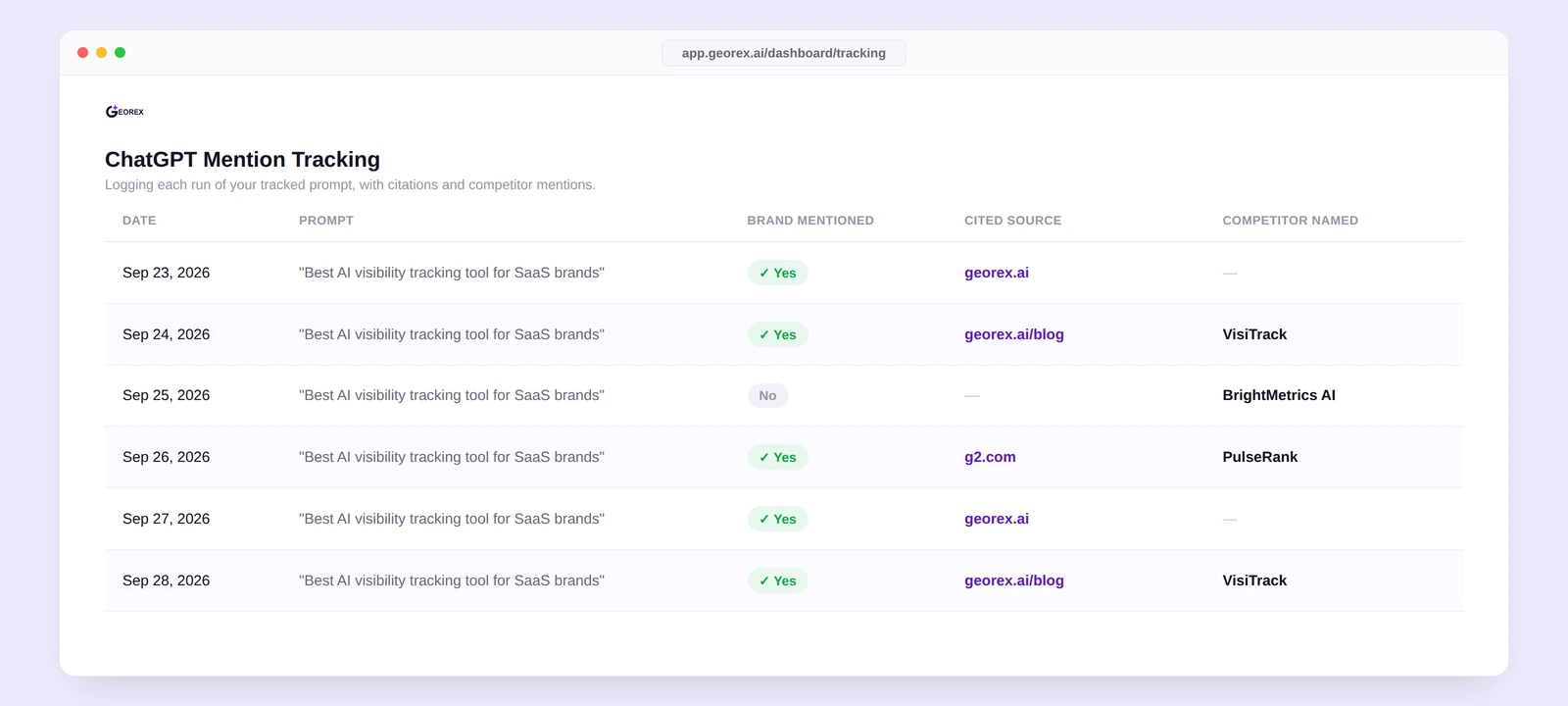
Testing means running the same buyer questions on a schedule and logging three outcomes separately: mentions, citations and competitor names. One response proves nothing on its own; a repeatable check turns the variation into a trend you can act on.
Illustrative example with sample data: one tracked prompt, checked daily
Build a representative prompt set
List the questions real buyers ask before choosing a vendor, not just searches for your company name. A 20-person software company might track "best project management tool for small agencies" alongside "is [Company] good for remote teams". Mix category, comparison and direct brand questions so the set reflects how people actually shop.
Track mentions, citations and competitors separately
Measure
What to record
What it tells you
Brand mention
Whether the brand name appears anywhere in the answer
Whether ChatGPT knows and names you at all
Citation of your page
Whether one of your URLs is a cited source
Whether your own pages are the evidence behind the answer
Competitors named instead
Which rivals appear when you do not
Who is winning the same prompts, and how often
Prompt and date
The exact wording and the date it ran
Real change over time versus normal variation
Tools such as GEOREX AI automate this: it asks ChatGPT and other AI engines the prompts your buyers ask and records whether your brand is mentioned, whether your pages are cited and which competitors are recommended instead. To see where you stand today, you can start with a free AI visibility audit.
Repeat checks and keep a dated record
Run the same prompt set weekly or monthly rather than once, and keep a dated log. You will see whether mentions, citations and competitor appearances are moving, instead of reacting to one lucky or unlucky answer.
Yes. OpenAI runs GPTBot and OAI-SearchBot as separate crawlers with independent robots.txt rules, so a site can block GPTBot to opt out of model training while still allowing OAI-SearchBot. Blocking OAI-SearchBot is what removes a site from ChatGPT Search answers.
How to Measure AI Visibility: Mentions, Citations and Share of Voice
The three numbers that measure AI visibility, how to calculate each one, how to build a prompt set that stays comparable, and where AI traffic shows up in GA4 and Search Console.