GEO vs SEO: What Changes, What Stays the Same, and Where to Start
M. Zeeshan, Founder of GEOREX AI
Generative Engine & AI Search Intelligence
Share:
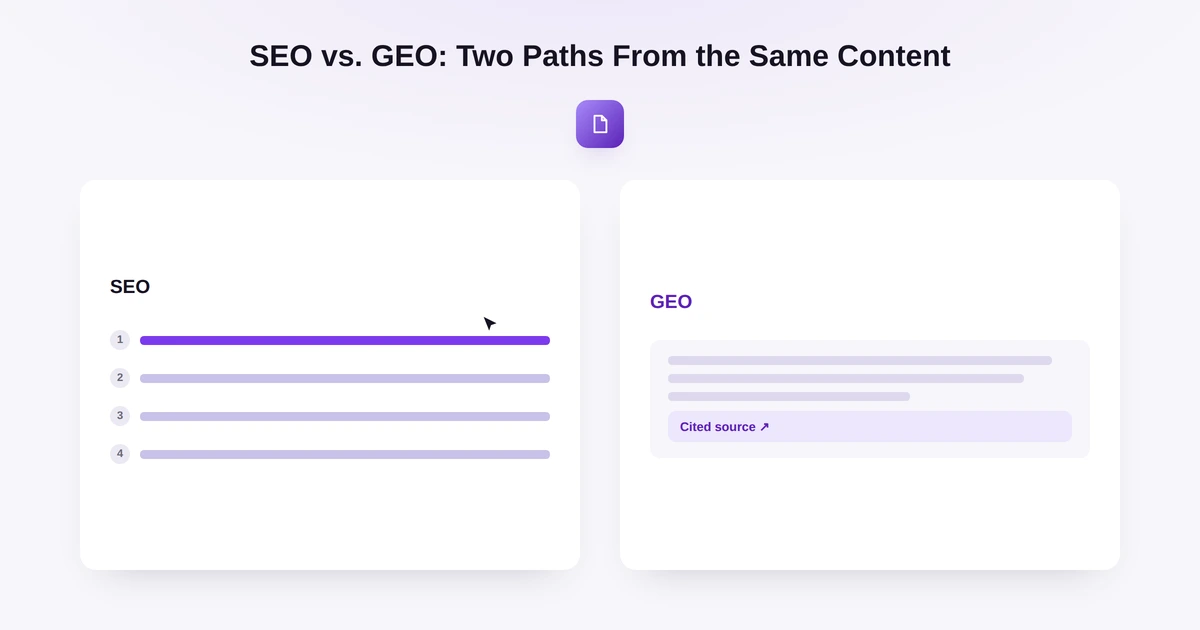
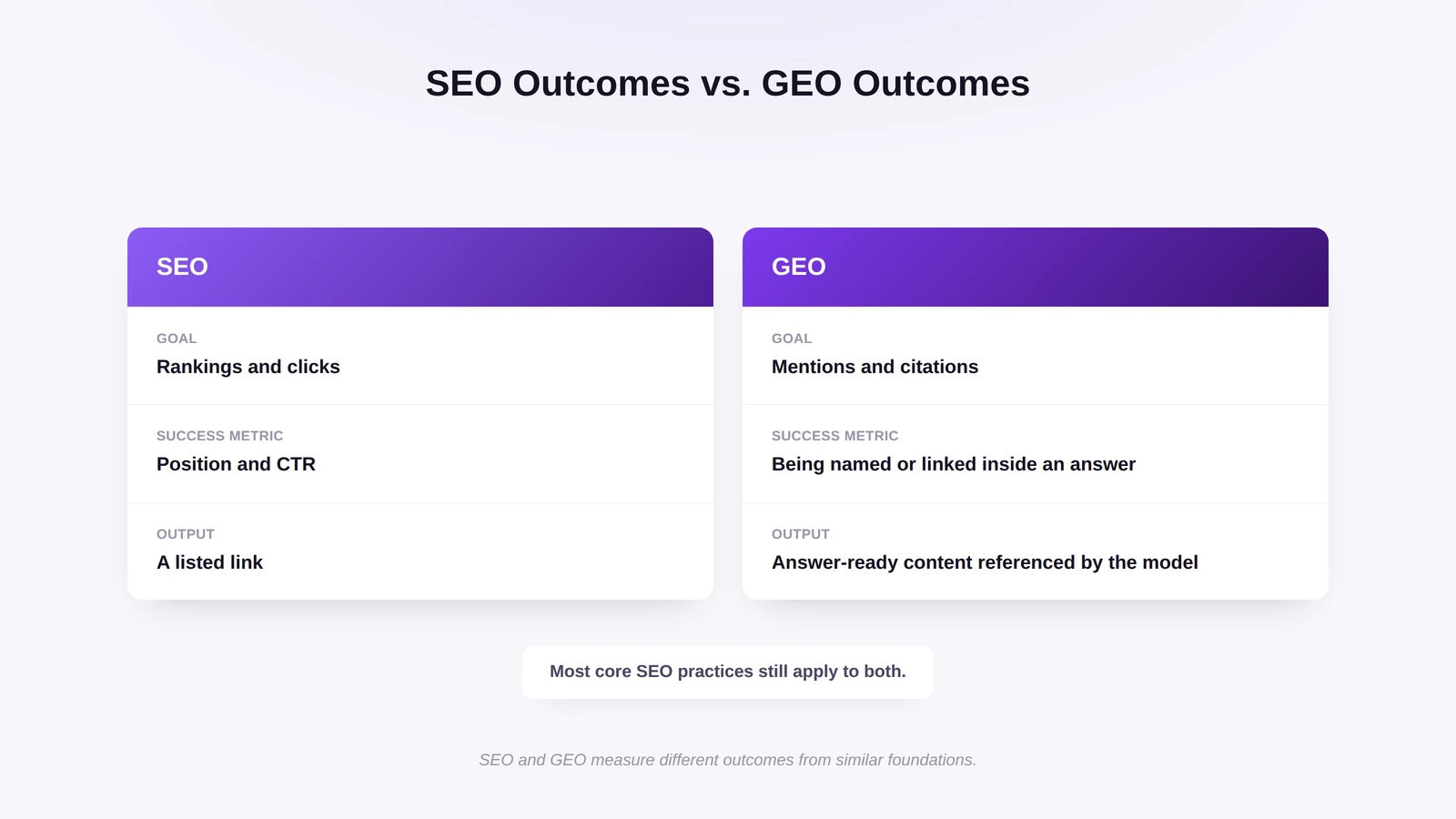
"SEO earns rankings and clicks in search results; GEO earns mentions and citations inside AI answers from ChatGPT, Gemini, Perplexity and Google's AI features. Most SEO foundations still apply, and GEO adds three things on top: content that answers questions directly, mentions on third-party sites, and a different way of measuring success."
Key takeaways
Google says existing SEO best practices still apply to AI Overviews and AI Mode, and no special schema or AI-specific file is required.
The unit of success changes: GEO counts mentions and citations in AI answers, not a ranking position.
AI answers vary between runs and often name brands without linking them, so one screenshot proves nothing.
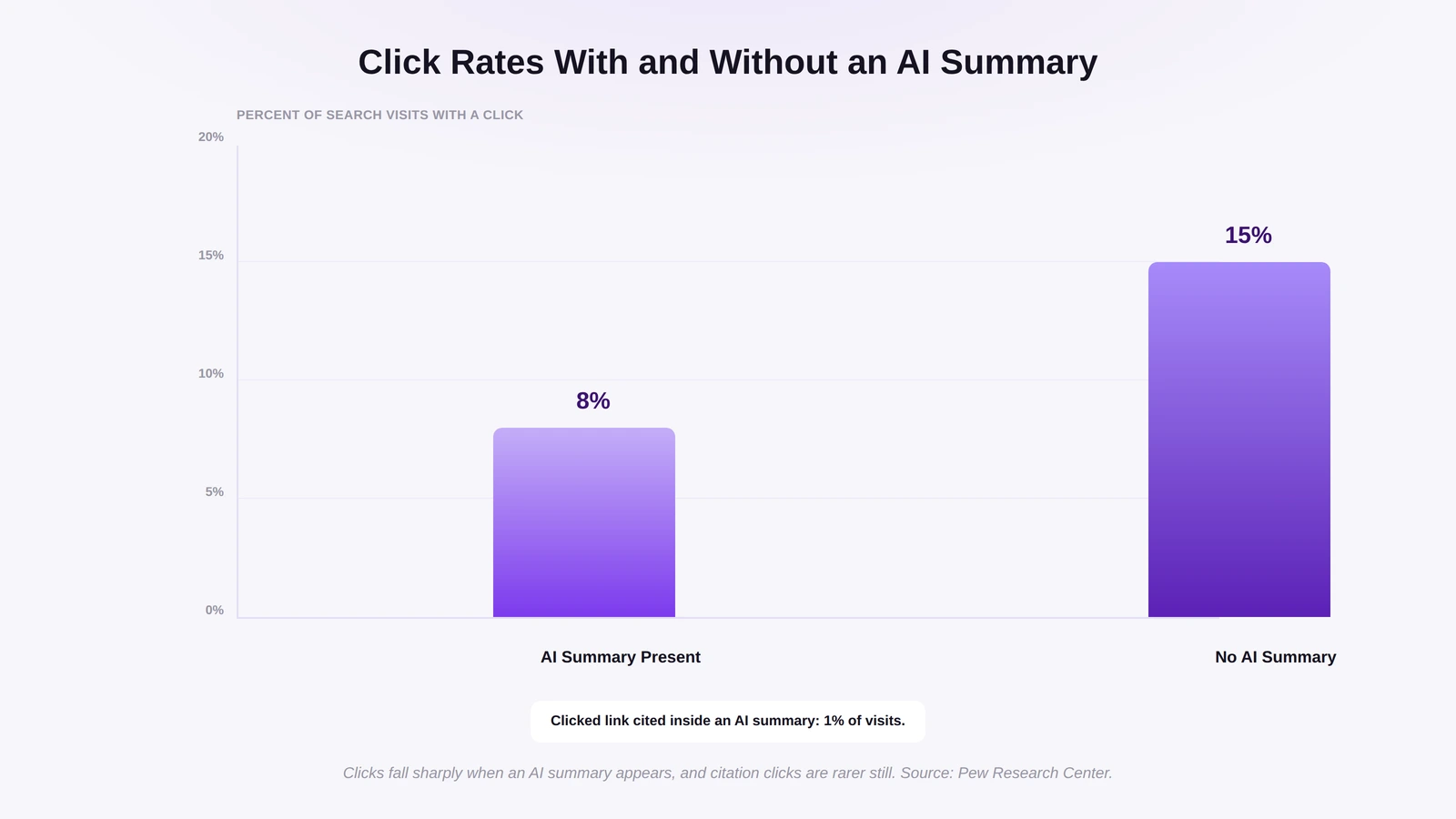
Pew Research Center found users clicked a traditional result in 8% of visits with an AI summary, versus 15% without one.
Keep investing in SEO and add GEO where AI answers show a visibility gap; a 90-day plan is enough to set a baseline and see first results.
What stays the same between SEO and GEO?
The foundations. Google says its existing SEO best practices remain relevant to AI Overviews and AI Mode, and that there are no extra requirements to appear in them: no special schema markup and no new AI-specific file (Google Search Central). A page still has to be indexed and eligible to show a snippet before it can be used as a source. For the wider picture, see our guide to .
M. Zeeshan, Founder of GEOREX AI
Author
Founder of GEOREX AI, an AI visibility platform that tracks how brands actually appear across ChatGPT, Claude, Perplexity, and Gemini, and turns the gaps it finds into a prioritized action plan.
Boost Your Brand in Generative Search
Turn AI engines into your highest-converting acquisition channel.
GEOREX monitors how ChatGPT, Gemini, Google AI Overviews, Perplexity, and Claude cite your brand across thousands of real buyer queries and provides actionable optimization playbooks.
Google recommends allowing crawling, putting important content in text rather than only in images or scripts, and linking related pages internally. A product page that hides its prices behind JavaScript is a problem for classic search and AI answers alike, and the fix is the same: server-render the content. Other AI engines run their own crawlers, which the technical GEO checklist covers bot by bot.
Helpful content and verifiable expertise
Content written for people, by someone who knows the subject, still wins. Structured data should match what the page shows; if your markup lists a price the page no longer displays, that mismatch costs trust in search snippets and AI summaries alike. None of this guarantees a citation, but it removes the reasons to be left out.
What changes when search becomes an AI answer?
Four things change: what counts as success, how people ask, how stable the results are, and where the evidence about you comes from.
Success is a mention or a citation, not a ranking
In GEO, success means an AI answer names your brand or cites your page. The KDD 2024 paper that coined the term treats visibility as a source's presence and influence inside a generated answer, not a position in a list, and found that GEO methods can raise that visibility by up to 40%. A company that ranks third for its main category keyword can still be absent from the AI answer if the engine cites three competitors instead.
Longer, conversational prompts
People ask AI tools full questions, not keywords. Pew Research Center found Google showed an AI summary for 53% of searches of 10 words or more, but only 8% of one- or two-word searches (Pew's 2025 analysis). Google's AI features also break one question into several related searches ("query fan-out"), so a page can be pulled in for a sub-question it answers well.
Ask the same AI engine the same question twice and you can get different brands. In Conductor's AI recommendation consistency study, only four of every ten brands named for purchase-intent prompts appeared in both of two runs. SEO rankings move too, but slowly; AI answers need repeated checks before you draw conclusions.
Mentions without links, and third-party sources
AI answers often name a brand without linking to it, and they frequently cite third-party pages (reviews, comparisons, news) rather than the brand's own site. Similarweb's research, reported by DataReportal, points to expert commentary, press coverage and credible social mentions as factors that can influence AI visibility. That makes digital PR and earned coverage part of GEO, not a separate job.
How do SEO and GEO compare, area by area?
Area
SEO
GEO
What to do
Goal
Rank and earn the click
Be named and cited in the answer
Track both, side by side
Unit of success
Position for a keyword
Mention and citation for a prompt
Build a fixed prompt set of real buyer questions
Query style
Short keywords
Long, conversational questions
Answer the exact question in the first lines of the page
Stability
Rankings move slowly
Answers vary between runs
Check each prompt several times per period
What are AI answers doing to clicks?
They reduce them, while AI referrals stay small. When Google showed an AI summary, users clicked a traditional result in 8% of visits, against 15% when no summary appeared, and clicked a link inside the summary itself in just 1% of visits (Pew, July 2025).
Share of search visits with a click. Source: Pew Research Center, 2025
At the same time, traffic from AI tools is growing from a small base. BrightEdge found AI search referrals rising month over month from January to August 2025 but still under 1% of total referrals, with organic search driving most traffic and conversions (BrightEdge report). Chartbeat saw ChatGPT referrals to publishers grow more than 200% year over year while staying under 1% of pageviews (Chartbeat data). In 2024, Gartner predicted that traditional search engine volume would drop 25% by 2026 as people turn to AI chatbots and virtual agents (press release); treat that as a forecast, not a measurement.
The practical reading: AI visibility and website traffic are separate outcomes. A brand can be cited more often while clicks fall, so measure them separately; how to do that is covered in how to measure AI visibility.
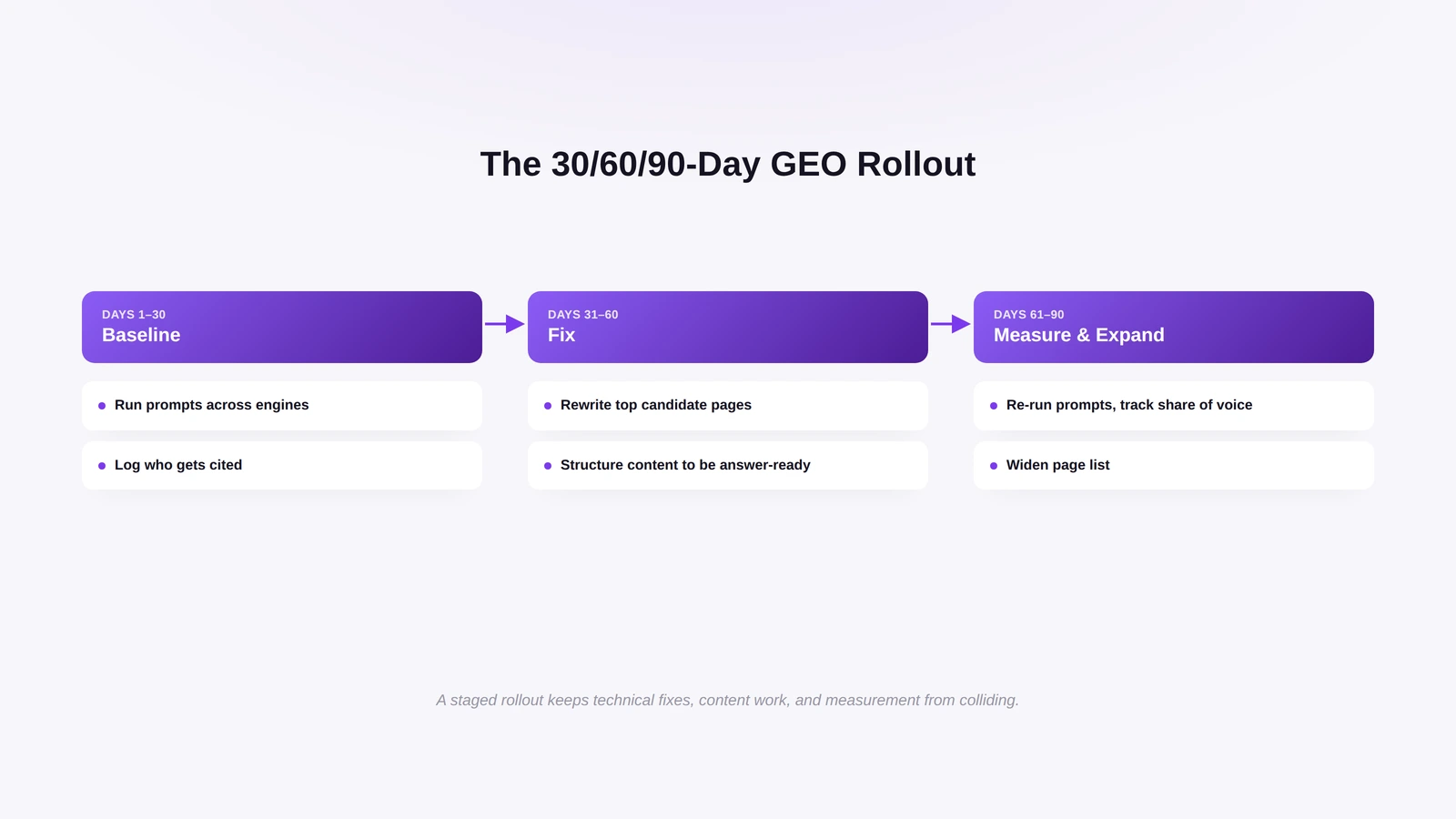
Where should a team start with GEO in the first 90 days?
Set a baseline, fix the pages most likely to be cited, then measure and expand.
Days 1 to 30: baseline
Run a prompt audit: 20 to 40 questions a buyer would ask ChatGPT, Gemini, Perplexity or Google AI Mode, covering problems, comparisons, pricing and "best for" questions in your category.
For each answer, record whether your brand is mentioned, whether your site is cited, and which competitors appear. Keep mentions and citations as separate counts.
Check technical access: crawling allowed (including AI search bots), main content in the HTML, structured data matching the page.
Shortlist 10 to 15 pages that already rank or are mentioned inconsistently. These are your best rewrite candidates.
Days 31 to 60: improve pages and evidence
Rewrite the shortlisted pages to answer the audited questions in their first lines, then add specifics: numbers with sources, steps, examples and comparison tables.
Strengthen internal links between related pages.
Work on third-party mentions: comparison roundups, review sites, expert commentary and industry press that AI engines already cite in your category.
Days 61 to 90: measure and expand
Rerun the same prompt set with identical wording and compare mention rate, citation rate and competitor share.
Expect different speeds. Pages that are already indexed and cited can change AI answers within weeks of a re-crawl; a new site, or a brand with few third-party mentions, usually needs several months.
Expand to adjacent topics only once the first round shows movement. A tool such as GEOREX AI runs this measurement for you, tracking mentions, citations and share of voice across ChatGPT, Gemini, Google AI Overviews, Perplexity and Claude.
How should teams split SEO and GEO effort and budget?
Keep most of the budget on SEO and add GEO as a layer, not a replacement. Organic search still drives most measurable traffic and revenue, and GEO depends on the same crawlable, trusted pages.
For most B2B and SaaS teams, GEO does not need a new hire to start. The SEO or content lead can own the prompt set and page rewrites, PR or communications can own third-party mentions, and a developer needs only a few hours for the technical checks. Move more time to GEO when your audit shows a real gap: your category appears often in AI answers but your brand does not.
Dropping SEO for GEO: Crawlability, indexing and links feed the sources AI engines draw from; cutting them removes what GEO depends on.
Chasing hacks: In the KDD 2024 tests, keyword stuffing gave little or no gain and ran 10% below the baseline on Perplexity, while adding citations, quotations and statistics helped. Write clearer, better-sourced pages instead.
Judging GEO on one screenshot: One answer is one prompt, one run, one moment. Use repeated checks across engines before deciding anything.
Reading AI visibility as traffic: A citation is not a visit; report the two separately.
No. Google says its AI features have no additional technical requirements and need no special schema or new AI-specific files. It recommends the usual basics instead: allow crawling, put important content in text, link pages internally and keep structured data consistent with the visible page.
How to Get Your Content Cited in Google AI Overviews
What makes a page eligible for Google AI Overviews and AI Mode, how query fan-out picks sources, which snippet controls matter, and how to measure citations and clicks.