How to Get Your Agency Recommended by ChatGPT (We Checked 10 US Cities)
M. Zeeshan, Founder of GEOREX AI
Generative Engine & AI Search Intelligence
Share:
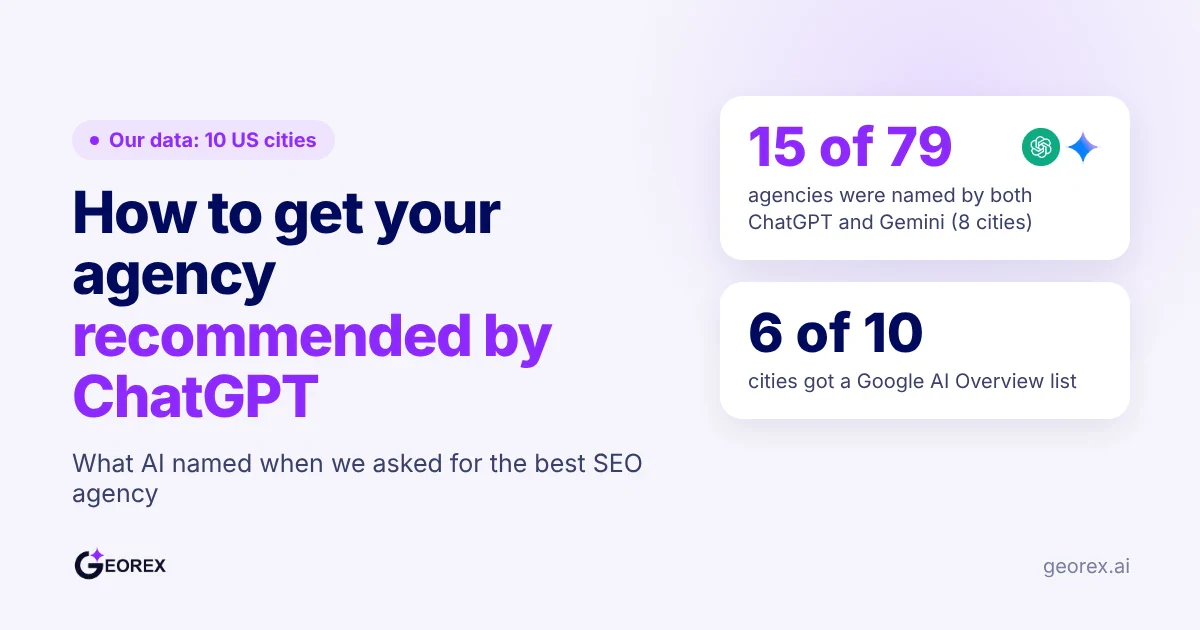
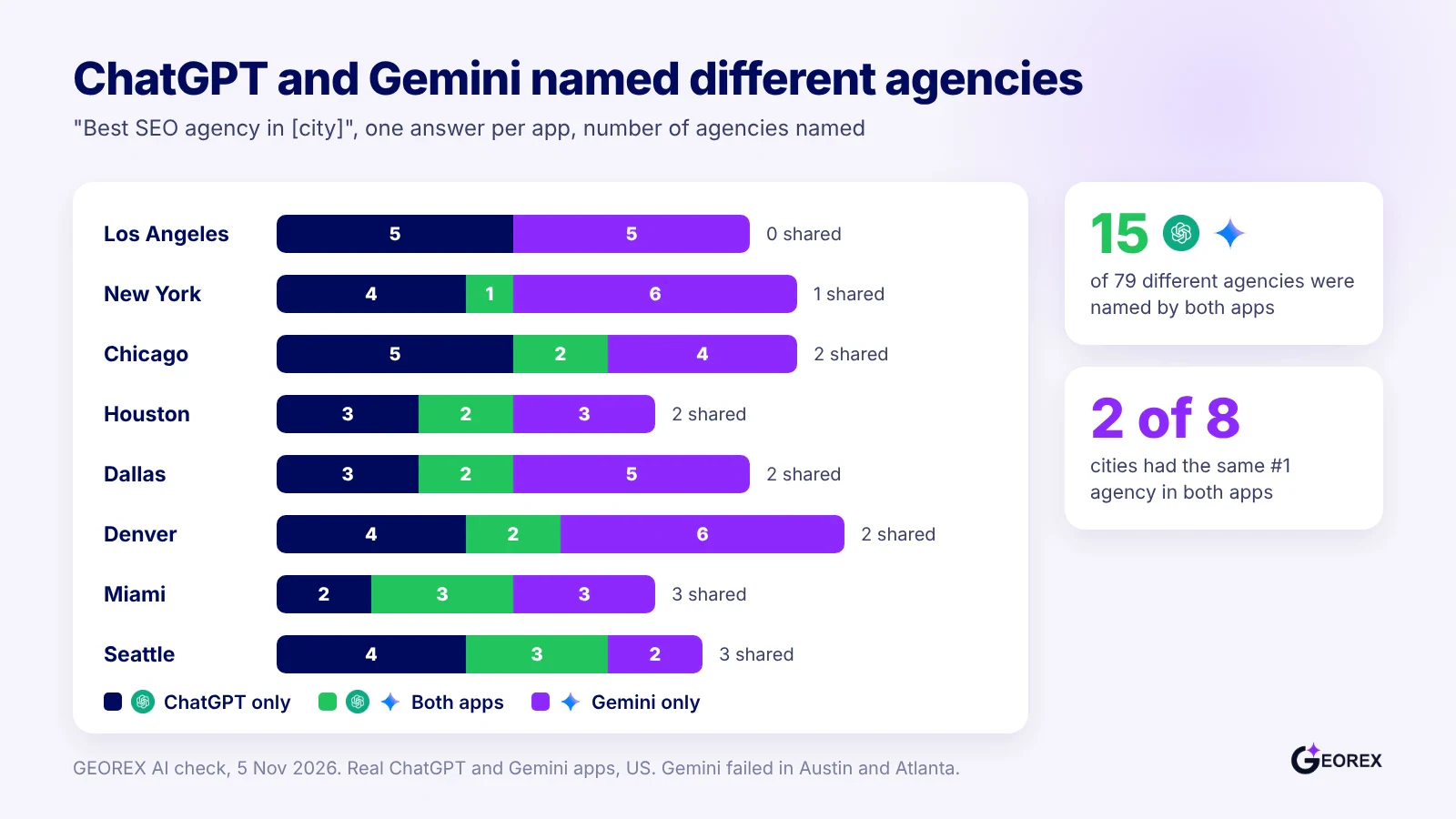
To get your agency recommended by ChatGPT, make your services and cities easy to verify on your own website and on the directories AI cites, collect genuine client reviews, and check ChatGPT and Gemini every month. When we asked both apps for the best SEO agency in 10 US cities, they shared only 15 of the 79 agencies named in the 8 cities where both answered. One app never shows the full picture.
Key takeaways
ChatGPT and Gemini named only 15 of 79 agencies in common across 8 cities, and named the same agency first in only 2 of them.
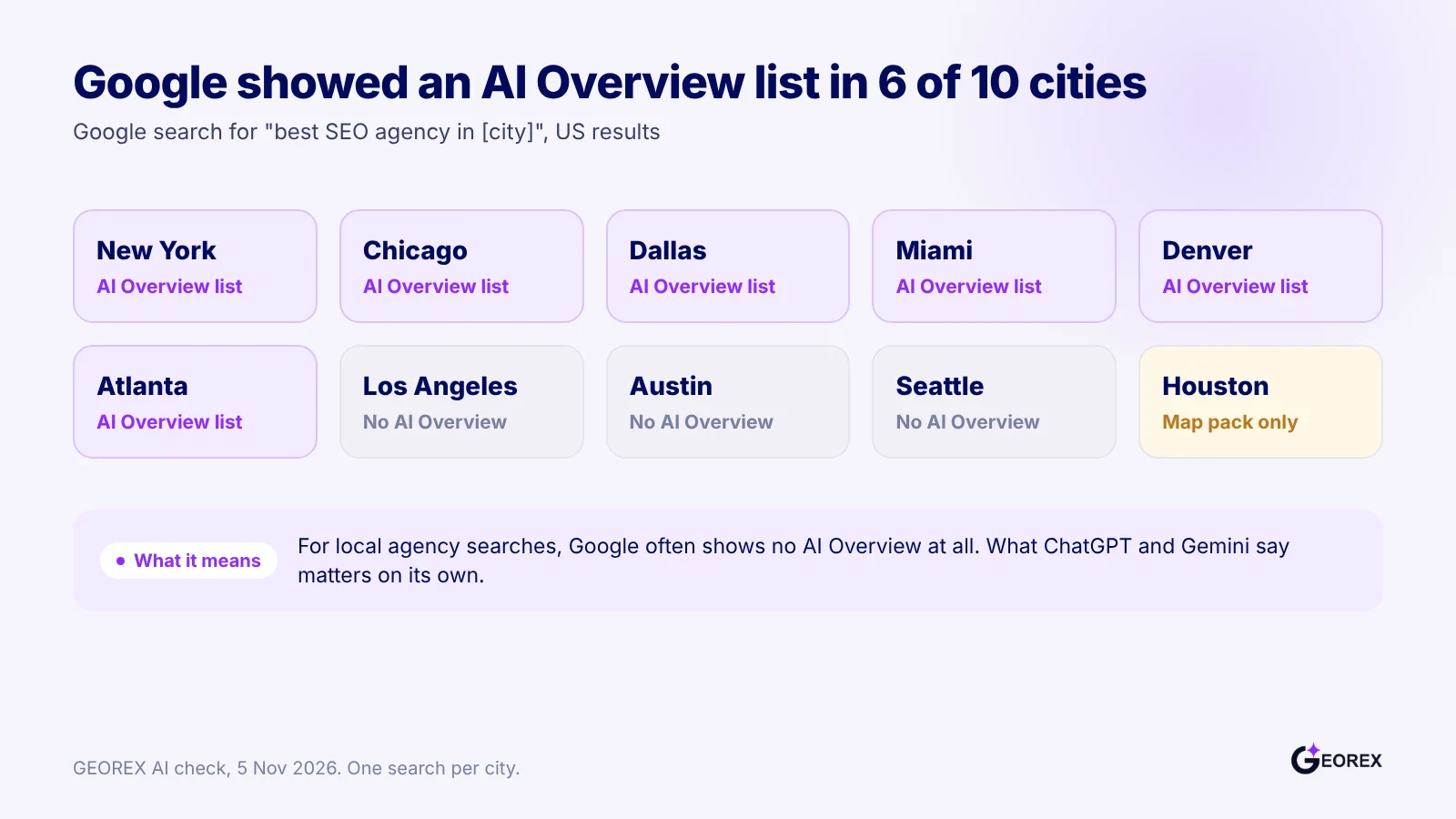
Google showed an AI Overview list in only 6 of 10 cities.
The most cited sources were directories such as Clutch, The Manifest and GoodFirms, plus the agencies' own websites.
Keep directory profiles complete, collect genuine client reviews, and give each city and service a clear page.
Check both apps every month with the same questions, and log mentions separately from citations.
What did ChatGPT and Gemini recommend in 10 US cities?
A check run on 5 Nov 2026 asked "best SEO agency in [city]" once per city, on the real ChatGPT app, the real Gemini app, and Google, across ten US metros. The point was not to rank agencies. It was to see how much the three answers overlap when someone asks the exact same local question.
The table below shows what Google's AI Overview displayed and how many agencies both ChatGPT and Gemini named in the same city.
M. Zeeshan, Founder of GEOREX AI
Author
Founder of GEOREX AI, an AI visibility platform that tracks how brands actually appear across ChatGPT, Claude, Perplexity, and Gemini, and turns the gaps it finds into a prioritized action plan.
Free AI visibility audit
See how AI engines describe your brand today
Check ChatGPT, Gemini and Google AI Overviews in minutes. No credit card needed.
Across the eight cities where both apps answered, ChatGPT named 45 agencies and Gemini named 49. Only 15 agencies showed up in both apps, out of 79 different agencies named overall. That is a low overlap for such a specific question. In only two cities, Seattle and Denver, did both apps name the same agency first.
Scale matters too. At least two national agencies appeared in the results for five of the ten cities, meaning small local shops are competing against national brands for the same "best agency in my city" question. An agency that only tracks its own name in one tool is missing most of this picture.
Google search for best SEO agency in each city, 5 Nov 2026.
What the one-prompt snapshot can and cannot show
A single prompt per app shows what each app said on one day, nothing more. AI answers change between runs, so one check is a snapshot, not a ranking, and a missing mention today is not a permanent miss. What it can show is a pattern worth testing: Google skipping the AI Overview, ChatGPT and Gemini naming very different agencies, or national agencies showing up in many cities. For a reliable signal, repeat the same questions over time, in both apps, city by city.
Why do ChatGPT and Gemini recommend different agencies?
ChatGPT and Gemini recommend different agencies because each app can draw on different sources and interpret the same local query differently. Their answers are separate outputs, not a shared list, so a mention in one does not guarantee a mention in the other.
Our 50-brand study found the same split for brands: when at least one app named the brand, ChatGPT and Gemini agreed only 42% of the time (101 of 242 questions).
Agencies named by ChatGPT only, by both apps and by Gemini only, 5 Nov 2026.
Different apps, different answer sets
When you compare answers, record the agencies named and the sources cited beside them. That gives you something concrete to investigate beyond whether your agency appeared.
Check each source for an accurate agency profile, a clear description of its services and consistent information about its location. If an app cites a directory or review site, make sure the relevant profile is current and describes the work you want to be recommended for. A strong website alone may not tell the whole story when answers cite multiple kinds of sources.
Keep the question consistent across checks. Compare the same service and city in each app, then review the cited pages rather than treating every difference as a signal about agency quality. A different answer may reflect a different set of sources or interpretation, not a clear verdict on your business.
Which websites are feeding agency recommendations?
A small set of directories, plus each agency's own website, supplied most of the sources cited in our 10-city check. For the bigger picture beyond agencies, see how ChatGPT recommends brands.
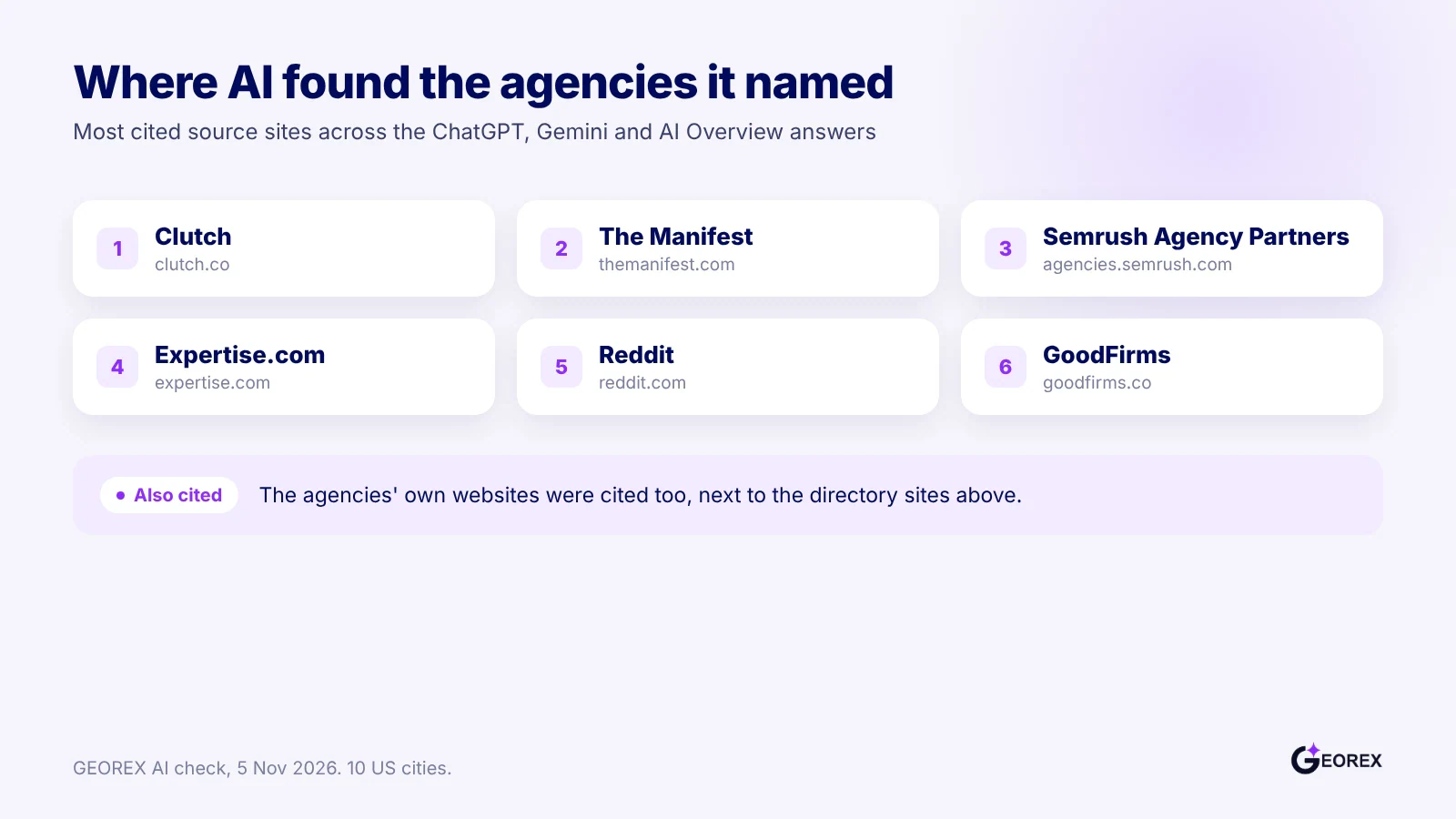
Most cited source sites across the ChatGPT, Gemini and AI Overview answers.
Directories that showed up most often: Across all answers in our 10-city check, the most cited source sites were clutch.co, themanifest.com, agencies.semrush.com (the Semrush Agency Partners directory), expertise.com, reddit.com and goodfirms.co. The agencies' own websites were cited too.
Clutch reviews a profile before it goes live: A Clutch profile covers your company name, tagline, team size, minimum project size, hourly rate, website, locations, contact details, an overview and your service focus, and Clutch's team reviews it before publishing (Clutch Help Center).
The Manifest ranks on focus and reviews: Rank there depends on your service lines and on client reviews: review count, recency and quality (Clutch Help Center).
Gemini leaned on review sites and "best X" lists: In our 50-brand AI visibility study, the sources Gemini showed were mostly review sites and "best X" lists, which matches the directory-heavy pattern in the city check.
Prioritize profiles and evidence buyers can verify
Treat directory profiles as data entry, not marketing copy: Fill every field Clutch and similar directories ask for, keep your hourly rate and project minimum current, and list the specific services you want to be matched with.
Ask for reviews steadily: Review recency is one of The Manifest's rank factors, so a steady flow of reviews fits it better than one burst.
Treat your own website as the anchor profile: Strategi, an AI SEO agency, analyzed 72,712 AI answers in 10 countries. When AI cited a business's own website, it named that business in 95.4% of answers, versus 26.3% when it did not. They report this as a correlation, not proof (Strategi). A page that clearly states your services, the cities you serve and who you work with gives AI something to cite.
Check which directories matter in your city: Compare the directories cited in your city's answers with the ones you are listed on, then fill the gaps.
How do you get your agency recommended by ChatGPT?
An agency improves its chances of being recommended by making its services, locations and track record easy to verify. This is part of generative engine optimization (GEO), and there is no single trick. A 2024 benchmark found that relevant statistics, credible quotations and reliable-source citations improved measured visibility, while keyword stuffing gave little to no improvement (GEO study).
Complete relevant directory profiles
Complete profiles on the directories where buyers look for agencies, starting with the ones cited in your city's answers, and keep the details current. Treat each listing as a verifiable record: use the same agency name, website, service descriptions and contact details as on your site.
Match your profile to the work you actually want, rather than adding every possible service. On The Manifest, service focus is one of the two rank factors. A broad list may also attract mismatched inquiries and make your strongest expertise harder to see.
Collect genuine client reviews
Ask satisfied clients for honest reviews and make the request part of your project closeout process. Google says local results mainly depend on relevance, distance, and prominence; complete business information, links, and review counts can help, but businesses cannot request or pay for better local rankings (Google Business Profile Help). Reviews may support visibility, but they cannot guarantee a position.
Reviews feed both directory rank and local visibility, so keep the request process steady and voluntary. For example, an agency could ask each client after a completed project, then respond to reviews with specific, professional details. Avoid incentives or scripted praise that could undermine trust.
Do not copy reviews from directories into review markup on your own site. Google prohibits aggregating reviews from other websites in that markup, and a business cannot earn review stars from reviews it controls on its own site (Google Search Central). You can still display testimonials for readers, but do not mark them up as eligible review ratings.
Build useful city and service pages
Build city and service pages that explain what your agency does, where it works, and what evidence supports its claims. Give each page a distinct purpose: describe relevant services, local experience, project examples, and the types of clients you serve. Avoid creating near-identical pages that swap only the city name.
Use specific evidence where you have it, such as a project outcome, a client quotation, or a relevant statistic, and identify its source. The GEO benchmark found these additions improved measured visibility, while keyword stuffing offered little to no improvement (GEO study). For example, a page for an agency serving Austin could explain its work for local clients and link to a detailed case study, rather than repeat “Austin agency” throughout.
Keep business details consistent
Keep your agency’s name, address, phone number, website, service focus, and location descriptions consistent across its site and directory profiles. Check important listings when contact details or service coverage change, and correct outdated records instead of adding competing versions. Consistency helps clients and systems reconcile which business a page describes.
Add accurate schema and keep AI crawlers allowed
Use accurate structured data and allow eligible pages to be crawled and indexed. Google says AI Overviews and AI Mode require no special technical optimizations beyond Search eligibility and foundational SEO; pages must be indexed and eligible for a snippet, and inclusion is not guaranteed (Google Search Central). Check that important pages are not blocked from crawling or marked noindex, and keep schema aligned with visible page content.
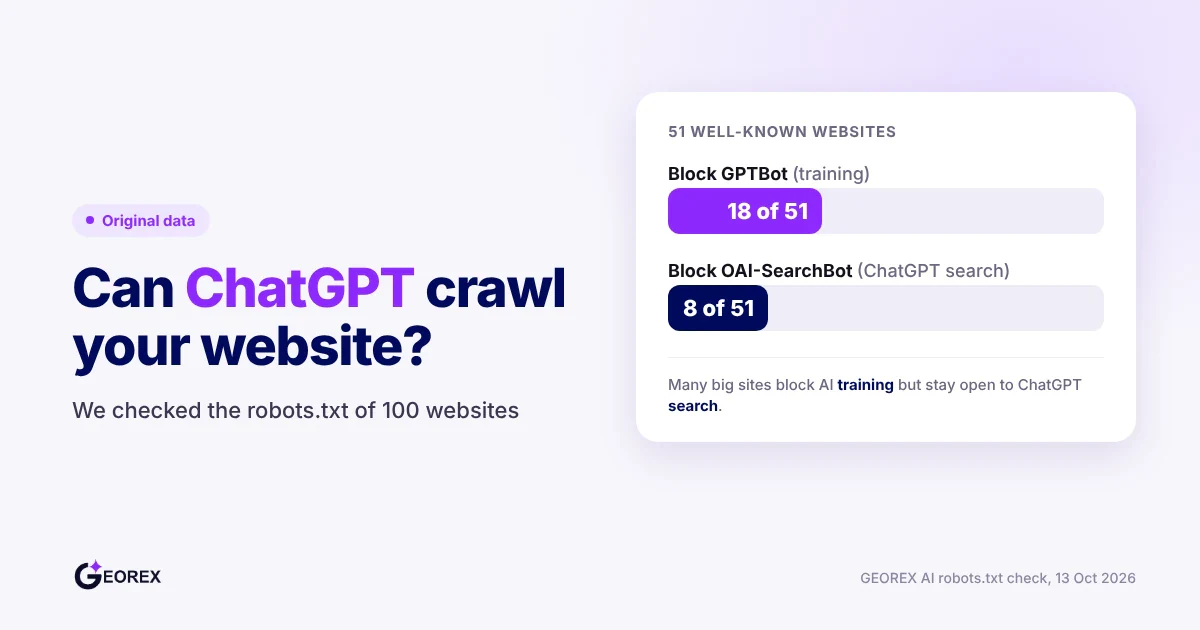
For ChatGPT search, OpenAI uses a crawler called OAI-SearchBot, and OpenAI says sites that opt out of it will not be shown in ChatGPT search answers. Our AI Crawler Checker shows in a minute whether your robots.txt blocks it.
Several common SEO moves show little or no link to AI recommendations based on the evidence so far. Treat these as low priority or active risks, not required tasks for an agency website.
Keyword stuffing: Benchmark tests on generative engines found that packing a page with target keywords gave little to no gain in measured visibility. Adding real statistics, credible quotes and citations to reliable sources did help (GEO: Generative Engine Optimization).
Paying for a better local ranking: Google says local results are based mainly on relevance, distance and prominence, and that there is no way to request or pay for a better local ranking (Google Business Profile Help).
Manipulating review stars: Google's review snippet rules do not allow aggregating reviews from other websites, and a business cannot get star ratings from reviews it controls about itself (Google Search Central). Breaking these rules can cost you rich results.
Checking only ChatGPT: In our 10-city check, the two apps shared only 15 of 79 agencies. A ChatGPT-only report misses most of what Gemini says about your city.
How can you check and track AI visibility?
You check AI visibility by running the same question on ChatGPT and Gemini on a fixed schedule, logging what each app names and what it cites, then comparing results over time instead of trusting one answer.
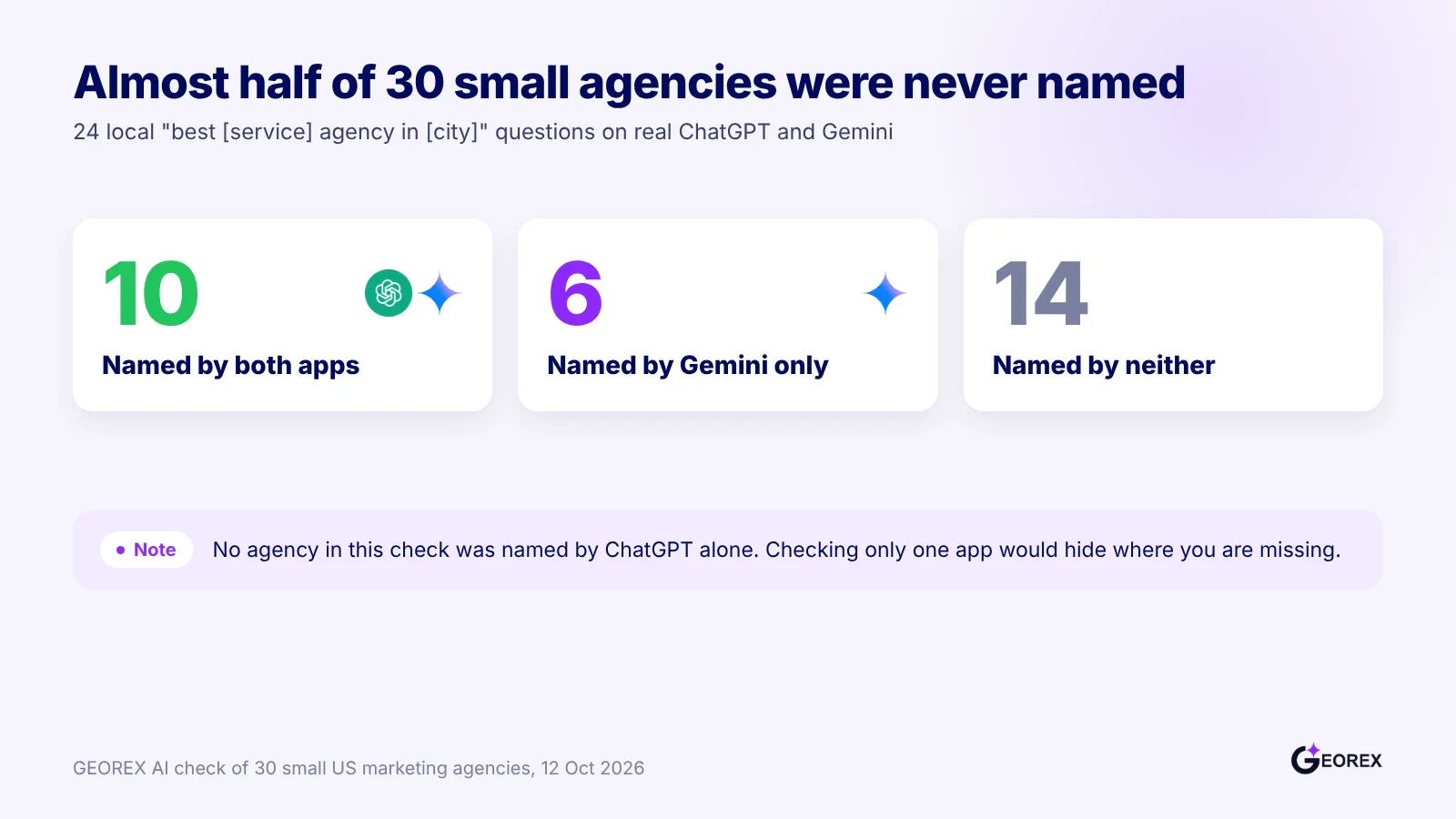
Our 12 Oct 2026 check of 30 small US agencies on 24 local questions.
Run a consistent monthly check
Pick 3 to 5 questions that match how a prospect would ask, such as "best SEO agency in [city]" or "best [service] agency near me."
Run each question on the real ChatGPT app and the real Gemini app, using the same wording every time.
Run it on the same day each month so the results are comparable.
Note whether a Gemini answer shows a Sources button. Google states that not every Gemini response includes source links, so a missing button means that answer had none, not that the check failed (Google Gemini Apps Help).
Record mentions and citations separately
Log a mention: does the answer name your agency, anywhere in the text?
Log a citation: does the answer link to your website, a review profile, or a directory page about you, such as Clutch.co or GoodFirms?
Keep the two counts in separate columns. An agency can be mentioned with no citation, or cited without being named in the prose.
Note which domain carried each citation. This tells you which directory profile or page to improve next, not just whether you were visible.
Compare results across apps and time
Build a simple log: date, question, city, app, mentioned (yes or no), cited (yes or no), source domain.
Compare ChatGPT and Gemini for the same question and date. In our 12 Oct 2026 check of 30 small US marketing agencies across 24 local questions, 10 agencies were named by both apps, 6 by Gemini only and 14 by neither. None was named by ChatGPT alone.
Treat one missed run as noise. If you miss the same question three months in a row, act on it.
If you track many questions across several apps, a spreadsheet gets slow. GEOREX AI tracks answers from ChatGPT, Gemini and Claude over time, with Perplexity as an add-on. To start for free, the free AI visibility audit tests 10 buyer questions live on ChatGPT and shows who it names instead.
Make your agency easy to verify. Keep complete, current profiles on the directories AI cites for agencies, such as Clutch, The Manifest and GoodFirms. Collect genuine client reviews there. Give each service and city you serve a clear page that answers the buyer's question first. Then check ChatGPT and Gemini every month with the same questions. No step guarantees a mention.
No. Google Maps rankings come from Google's local results, and ChatGPT writes its own answer. In our check, Google did not show an AI Overview at all in 3 of 10 cities, and ChatGPT and Gemini shared only 15 of 79 agencies. A strong Google Business Profile helps local search, but you still need to check each AI app on its own.
No, the current evidence does not support that claim. Google states that AI Overviews and AI Mode carry no special technical requirements beyond standard Search eligibility and foundational SEO (AI Features and Your Website). Schema can support rich results in Search, but nothing confirms it directly drives ChatGPT citations, so indexable, accurate content matters more than markup alone.
Only where you really work in that city and have something specific to say. We found no evidence that a page per city by itself makes AI recommend an agency. A thin page that only swaps the city name helps nobody. One useful page with real local projects, clients and services is worth more than ten near-copies.
Run the same prompt, such as 'best SEO agency in [city],' on the ChatGPT and Gemini apps on a regular schedule, and record whether your agency is named and whether a link to your site appears. In Gemini, check for the Sources button beside the answer; Google says its absence means that response gave no links (View related sources from Gemini Apps).
Because chatbot answers are not fixed. One response is a snapshot, not a stable ranking. Asking ChatGPT or Gemini the same question again can return a different set of agencies even when nothing on your website changed. Tracking the same questions over several runs gives a far more reliable picture than any single answer.